Observing a filmmaker being a spectator is every bit as delightful as watching a film in their presence.
A report by Panagiota Stoltidou
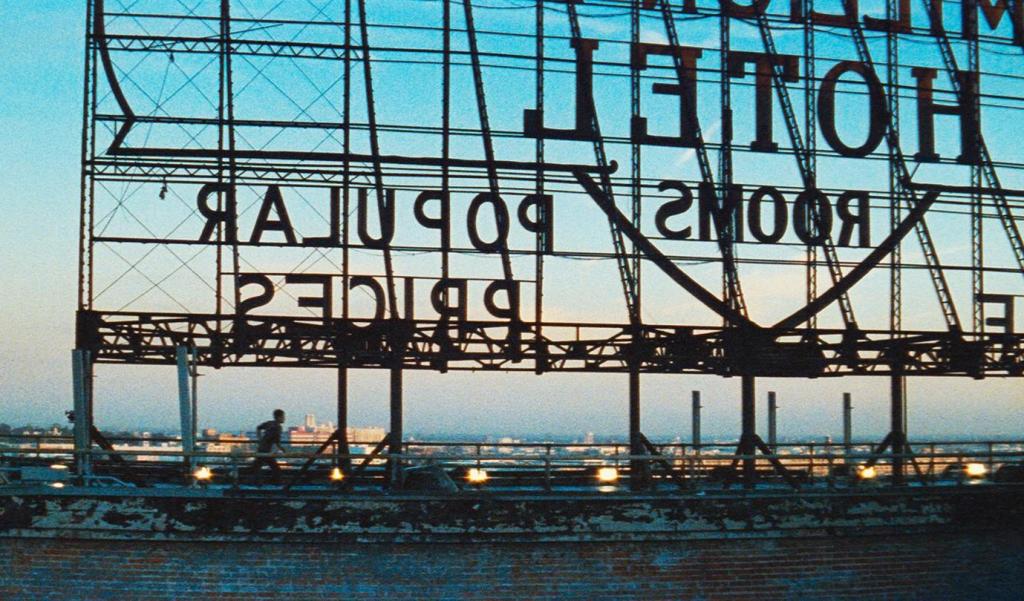
In the screen in front of us, the camera pans slowly over a clear L.A. sky. Now and then, the tips of tall skyscrapers interrupt the blue expanse. Like the conductor of a faraway orchestra, Wim Wenders raises his arms –his elbows are slightly bent, his palms facing down– only to lower them a moment later. The ever-obedient camera follows his downward movement, tilting from the sky onto the rooftop of the notorious Million Dollar Hotel. There we see a young man, picking up speed and running off the edge of the building in slow motion. Wenders’ knees are pressed against the back of the seat in front of him and his hands have rested on top of them, unmoving and satisfied. The film has begun.
A week prior to the German premiere of the restored 4K version of Wenders’ eccentric comedy-drama The Million Dollar Hotel (2000), starring Jeremy Davies and Milla Jovovich, I sent an email to Yorck Cinemas to confirm that the director would attend the Berlin screening himself. “Herr Wenders ist zu der Veranstaltung anwesend,” came the response that made me feel remorseful for not having also referred to the man in question as “Herr,” instead using his full name in my initial message. Shortly after arriving at Kino International in Berlin Mitte for the premiere, I stop mid-sentence while talking to my friends by the bar. Wenders is standing a couple of meters away from us, talking amicably to a group of people. He is wearing blue-framed spectacles, sneakers and an impressive trench coat. I look around me, hoping to see many others gazing admiringly in his direction. The guests are scattered across the room, looking as deeply absorbed in their own conversations as the star of the evening, or waiting in line for a drink at the bar. I try to act cool too and order a beer, but when Wenders later passes in front of me to enter the theater, I have to bow my head in order to hide my schoolgirl grin.
During the screening, I catch myself turning my gaze away from the big screen and toward the dark figure of Wenders two rows ahead of me to my right. This happens often, every time he shifts in his seat or lets out a laugh, for instance, but also at quieter moments. Observing him as he watches his own film, his body still like the shadow of someone sleeping, I feel a rare and glamorous thrill, perhaps only comparable to that of watching someone looking at themselves in the mirror. When Wenders leaves the theater briefly for what I assume is a bathroom break, I take note of the exact time, and I begin to sense I am obsessed. My obsession, I think, does not imply the mystifying adoration of the one I watch. It does not have him nor his celebrity factor as its target, but rather a question: why is watching Wim Wenders in his role as spectator more fascinating than watching him come together as a filmmaker in the work that he directed?
In the days following the event, the question tugs at me constantly. As I mull it over, I come across a quote by the auteur himself on the website of the Wim Wenders Stiftung that emphasizes the project of the non-profit foundation:
People around the globe have seen my films, many have been influenced by them, and some of these films have become classics or cult films. In this sense they no longer belong to me anyways, but instead to a collective memory of cinema-goers of every age and many nationalities. It has been my desire for many years that in the future my work might belong only to itself, and thus to everyone. There is now a realistic and unique opportunity for this dream to come true. (emphasis mine)
Here, the director brings Argentine writer Jorge Luis Borges to mind in thinking of art, especially his own, as independent from its creator. The survival and integrity of a work seem to matter far more to him than its authorship. Having sat two rows behind Wenders at a screening of his own film, I can only half-heartedly endorse similar views. I have to insist: it is very exciting to watch someone engage with a work and know that it is them who envisaged and elaborated it.
I search my memory and reach for the image of Wenders at the beginning of the screening, replaying it in my mind’s eye. I conjure his hands. There is something very precise about his hands orchestrating the movements on the screen. They don’t waver. Indeed: they remember with such clarity that they can imitate a past gesture so acutely, it seems now as if they’re giving it a second life. For me, the privilege of watching Wenders watch Wenders lies primarily in the exceptional ability to glimpse into the alternative viewpoint of the artist as spectator – as the one finally standing outside of their own world, looking in. This viewpoint seems to me a very intimate one, despite the temporally and spatially irreconcilable identities of Wenders the director and Wenders the spectator.
I think of Bruno Ganz in Wings of Desire (1987). Watching over the people of Berlin with fondness from his post up above or blending with them on the streets, he remains invisible and yet informs the workings of their lives in subtle ways. During the screening of The Million Dollar Hotel, Wenders, too, is less of a domineering puppet master than an inconspicuous angel. His sustained attention as spectator, the precision of his hands, his laugh: they all bear an intimacy that eventually seeps into the fabric of his work to resonate from within, invisibly.
The credits roll. After they turn on the lights, everything around me takes shape. A woman is standing on stage and calling out the director’s name, her eyes furtively searching the crowd. The man that has been sitting close to me stands up. He climbs over the first row and trips slightly. “Sie hätten Ihre Reihe auch seitlich verlassen können,” the woman remarks as a joke. After he reaches the stage, she hands him a microphone and asks him a question. I try to catch his gaze, to no avail. Then I listen.




Leave a comment