
What kept me hooked was my unsatisfied thirst for meaning and depth in Garrel’s autofiction. My mind never wandered beyond the place where the 24-pictures-a-second led it safely. (That, I assure you, is my “truth.”) Le Grand Chariot offers a windy albeit predictable plot of a family affair which is also pretty to look at.
A review by Janek Kindel
Shortly before the film had its world premiere at the 73rd Berlinale, I caught Louis Garrel, son of director Philippe, on camera. His sisters Esther and Léna beside him, shielding a surreptitious Garrel senior from the press. All the while, I had been planted waiting among a plethora of 35mm pistoleers in the red-carpet trenches. With every gratuitous flaneur, the anticipation rose, causing us to gasp in unison to the beat of our photo flash orchestra. The Garrels’ presence struck me right away. I recalled Louis’ uncanny performance as Jean-Luc Godard in Redoutable. Meanwhile, Esther stood back to avoid stealing her brother’s show, but it was Léna’s ease on the carpet that ultimately granted me a photo. Philippe Garrel’s sly demeanor and lack of words kept me hunched at the edge of my seat. The director certainly knew how to let his art (and children) speak for himself, I thought. Prior to the screening, all I knew about the film was its autobiographical touch which the cast, consisting of Esther, Léna, and Louis, soundly manifested. Upon seeing the official film poster, I anticipated listening attentively to clever dialogues between intricate characters who would be comfortably embedded in the vintage colors of Kodak film. Shortly after my arrival in the auditorium upon last call, the Garrels appeared live on screen before the audience in a vis-a-vis of place and time.
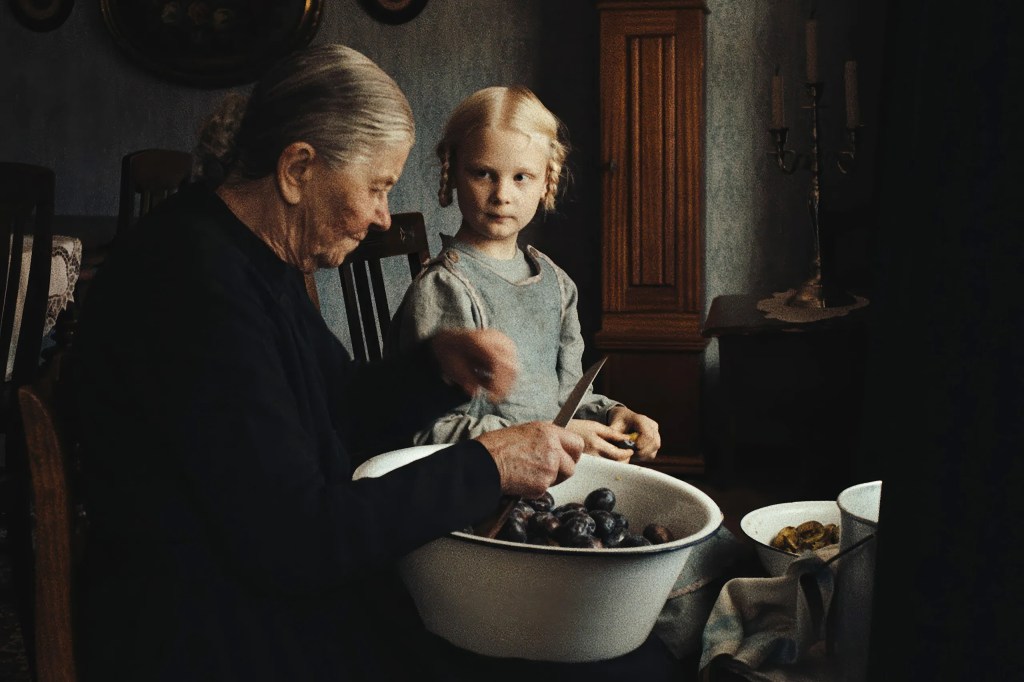
What is Philippe Garrel on about? The title Le Grand Chariot, or The Plough, or Der Große Wagen infers a certain degree of the ethereal – a nudge toward the lyricism of the mundane, invoking the auteurs of the nouvelle vague. Still at the edge of my seat, I began to observe a family of puppeteers, whose members count Louis (Louis Garrel), Martha (Esther Garrel), Léna (Léna Garrel), Aurélian Recoing as Père and Francine Bergé as Mamie. Garrel’s inspiration behind the film seems to be an autobiographical one, my brief research concluded that his father, actor Maurice Garrel, had himself been a puppet master under renowned hand puppeteer Gaston Baty. Early on, it becomes apparent that their revered hand puppet company and family business “Le Grand Chariot” had long peaked in the glorious days of puppeteer-yesteryear. Initially hired for maintenance, Pieter the painter (Damien Mongin) wound up causing more havoc than anything. Between fixing up the hand puppets, I saw him painting the literal and meta mis-en-scène of Le Grand Chariot. A promising character at first glance, Pieter unraveled to be nothing but a humanoid trompe l’oeil, spiraling into madness while reeling down the silver screen. The film’s violence towers over too many dead-beaten horses of auteur cinema: beside a couple of comedic reliefs, succeeding the two deaths of the film, like Louis removing the cross from his outspokenly atheist mamie’s coffin, every promising scene turned out to be a fluke. When the film cuts to Louis’ pronounced profile beside an exhaustedly dreamy Hélène (Pieter’s baby-mother) in bed, the dialogue remains blind to the screenplay. At one point, Louis decided to leave the “marionettes” behind to become a successful stage-actor, after which Martha took over the company business only to find “Le Grand Chariot” crushed by a tree during a thunderstorm. Quelle domage, cette orage. Of course, everything that could go wrong eventually does.
Embellished by the film’s ravishing pastel color palette, the plot invokes a style of French auteurism that, like Mamie and Père, has been unapologetically buried by Garrel for nothing but a forced giggle. Le Grand Chariot is gagging of nouvelle vague tropes. The overtest reference I recognized was Éric Rohmer. At times, Pieter the painter resembles Fabrice Lucchini’s characters in films like Les Quatre Aventures de Reinette et Mirabelle and even Parceval. In another scene he sits in a café with Laura for whom he had left his son’s mother Hélène, though lacking the moral intricacy of Rohmer’s characters in L’Amour, L’Après Midi. Louis’ character just paid homage to the director himself. Unfortunately, Philippe Garrel denied the women of Le Grand Chariot sufficient character development. Specifically, Esther’s and Léna’s characters showed plenty of untapped potential. Unlike Rohmer’s, Garrel’s dialogues never surpassed the threshold of the mundane. The numerous spins on all brows of French cinema and literature saw my own brows hang low in the men’s bathroom mirror after the screening.
To wax lyrically about this film, like its aesthetics infer to the eye, is about as difficult as finding depth in Philippe Garrel’s dialogues. Le Grand Chariot hardly offers more than an expired pastiche of French auteur cinema. Sunken deep into the seat, I caught myself rolling my eyes all too often at stale clichés like that of the failed artist Pieter who wrecks his paintings amid a mental meltdown in the metro. Although the soundtrack was fine, any song by Zanini would have served to solidify a better parody. Though, admittedly, I might as well have missed the point.




Leave a comment