A decades-long friendship faces its toughest, most existential challenge to date.
A review by Iliana Tsachpini
This year’s winner of the Venice Golden Lion Prize is none other than Pedro Almodóvar’s The Room Next Door (2024). The film marks a milestone as Almodóvar’s first English-language feature and his first to win a major international award. An adaptation of Sigrid Nunez’s novel What Are You Going Through (2020), the movie brings Almodóvar’s signature style and emotional depth into uncharted linguistic territory and delivers an exceptional pairing of Julianne Moore and Tilda Swinton as reunited best friends Ingrid and Martha.
The story centers on Ingrid, a successful writer, who unexpectedly reconnects with Martha, a close friend from her youth and a former war journalist now grappling with terminal cancer. Their reunion takes place in Martha’s hospital room in New York City, where the two engage in a number of conversations, peeling back the layers of their shared past. Martha, surprised yet comforted by Ingrid’s visit, recounts the pivotal moments of her life after they drifted apart. The dialogue is rich, textured, and deeply human, a celebration of shared memories that cements an unexpected yet fateful reunion.

Through the Spanish auteur’s tried use of flashbacks, the film seamlessly juxtaposes past and present, peeking at the characters’ backstories and answering lingering questions about their choices and fates. Through these flashbacks one is invited to explore the emotional complexity of Ingrid and Martha’s bond, as well as the gravity of their poignant reunion.
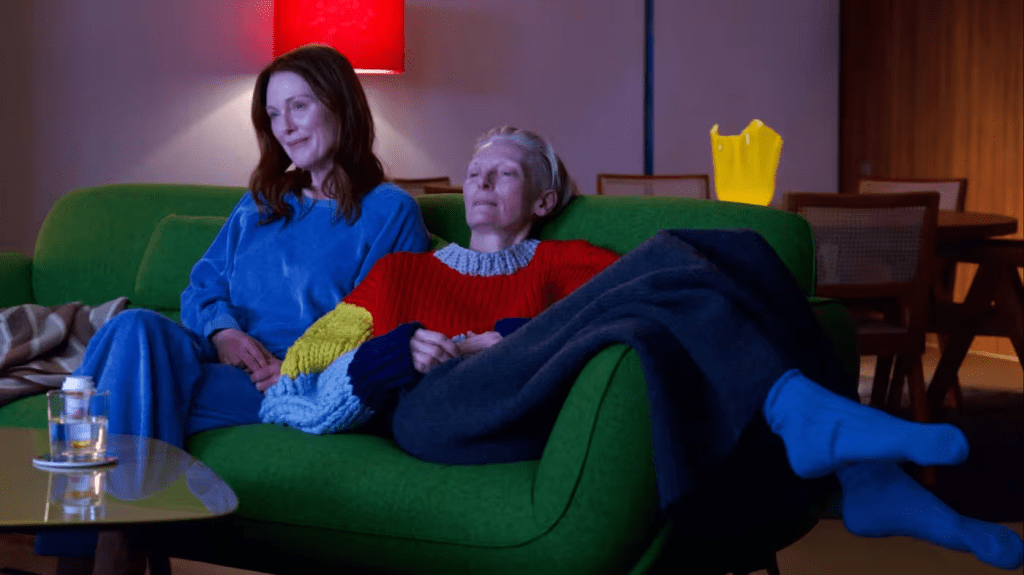
As the visits become more frequent, the friendship between the two women grows stronger, but so does the seriousness of Martha’s situation. When all hope for recovery fades, Martha decides to stop treatment and take control of her fate. She asks of Ingrid to remain nearby as she does so—to sleep in “the room next door”. This agreement lands them in a secluded villa in upstate New York, where the vibrant colors of the autumn scenery and the striking interior design offer a transatlantic twist on Almodóvar’s iconic visual language. The complementary hues of green and red dominate the frame and create a dreamlike atmosphere that feels estranging in its clean symmetries and angles.
While the film deals unflinchingly with the subject of death, it does so with an unusual sense of ease and normalcy. Ingrid and Martha discuss the terms of their agreement as though it were a routine topic, all while planning activities that encompass everything Martha wants to do before her time comes. Seeing them on the sofa, watching Martha’s favorite movies, one might think that they are just two friends spending some quality time together, when in reality they have to deal with the uncertainty of whether they will see each other again tomorrow.
There is, indeed, a palpable unease beneath the polished surface. Is this the result of Almodóvar stepping into uncharted territory with his first English-language film? Or does it stand in for the alienation one feels when confronted with the fading remnants of their once-vibrant life? Martha, who used to find joy and a strong sense of self in writing and reading, now struggles to reconnect with the activities that defined her. Her colorful bookshelves and drawers of war journals serve as haunting reminders of a life slipping away, while her shifting identity hovers as a still-living ghost over her vibrant environment. Almodóvar captures Martha’s rite of passage with a surreal touch: the villa becomes a liminal space where reality bends—a place warm enough to sunbathe yet cold enough for snowfall.

This surrealism acts as a counterbalance to the film’s heavy themes, offering moments of visual poetry and humor that temper the weight of impending loss. In the end, The Room Next Door is not merely a story of death but a reflection on friendship, memory and the courage it takes to accompany someone through their final journey.
Despite its poignant complexity and aesthetic brilliance, there remains a slight awkwardness throughout the film—a subtle tension that lingers, as though the very act of confronting death, in this extraordinary setting, feels somewhat out of place. Perhaps it is a reflection of the discomfort that comes with the inevitable: the difficulty of navigating death, a difficulty complicated further perhaps by all the grace and color that Almodóvar breathes into his work: all the life.



Leave a comment