Revisiting women’s (witch) trials, 400 years later.
A review by Iliana Tsachpini
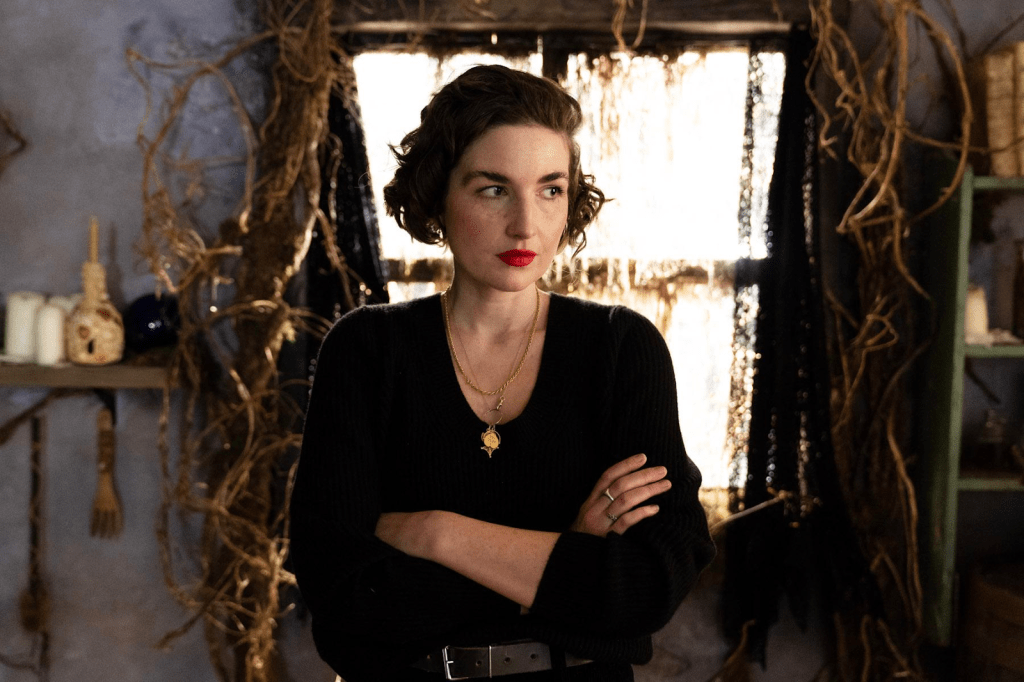
Written, directed and edited by Elizabeth Sankey, Witches (2024) delves into the dark terrain of postnatal mental illness through an intensely personal lens. To make this documentary, Sankey collaborated with a host of women who, like her, have experienced what she terms postpartum “madness.” Together, these women form a modern-day coven, finding solace and solidarity in each other’s stories. Drawing poignant parallels to their historical counterparts — women accused of witchcraft and brutally executed over 400 years ago — Sankey’s council of witches exposes the “crimes” that had once sealed female fates and are still not without stigma to this day: postpartum psychological disorders; healing powers; and the defiance of norms that society has set for women.
Witches is the director’s most successful venture into documentary yet, earning her the Best Feature Documentary prize at this year’s British Independent Film Awards. Like her previous films, this also stars Sankey, who faces the camera head-on and courageously recounts her own struggles with postnatal depression and anxiety. Following the birth of her son in 2020, Sankey’s depression reached a despairing point. After numerous attempts to access help, she was eventually admitted to a specialized psychiatric ward for mothers and children, where she found a network of support. In this accomplished documentary essay, the filmmaker is careful not to recount her story in a vacuum. Instead, she creates ample space for other voices and stories to resonate alongside her own. These are, mainly, the experiences of the women she met along her healing journey: stories of mothers who have similarly endured a range of postpartum mental illnesses, from depression to psychosis.

Through a series of intimate interviews, Sankey becomes both storyteller and witness. One particularly compelling conversation features Dr. Trudi Seneviratne, a perinatal psychiatrist who has herself also experienced the same symptoms she had treated in others. When Dr. Seneviratne sought help, the doctors initially dismissed her claims, diagnosing delusional tendencies. Only after Dr. Seneviratne’s husband intervened to confirm his wife’s profession did the doctors take her seriously. Reflecting on the experience, she admits: “Even as a perinatal psychiatrist, it took me years to accept that it had also been a full-blown psychosis or that it had dipped into psychosis. And that’s stigma.”
Postnatal mental illness is masterfully contextualized in Sankey’s meticulous montage. The interviews are woven into a rich tapestry of filmic fragments that traverse decades of visual history of female oppression and patriarchal dominance to offer (mostly) one-dimensional depictions of witches, new mothers, and women grappling with mental health struggles. Clips from Häxan (1922), Witchfinder General (1968), Rosemary’s Baby (1968) and The Witch (2015) breathe life into historical witch testimonies, while scenes from Girl, Interrupted (1999), Tully (2018) and The Snake Pit (1948) echo Sankey’s own experiences with mental illness.

Set alongside and against this film footage, the present-day discussions between Sankey and her friends are thus not only moving but also razor-sharp, offering a critical reflection on both history’s and, importantly, cinema history’s continuous demonization of women. I cannot quote all of the powerful testimonies here, but I will end with Sankey’s poignant question towards the end of the film:
“It’s been 400 years. Why do women still feel this way? Why are suicide rates rising? Why is there still so little awareness, knowledge, and support for these illnesses?”
Witches is a crucial step towards answering this question — this time in unison.

Leave a comment