The holiday season can often be equal parts beauty and chaos. Amid the social obligations, festive activities and endless talk about New Year’s resolutions, there does come a point where you just need a break from it all. For that much-needed interlude of self-isolation during the holidays – which we think should be entirely FOMO-free – we have curated a watchlist of festive viewing that captures the warmth and delight of the season without making Christmas into the centerpiece. Let us know your favorite non-Christmas Christmas film in the comments and ’tis the season!
Iliana Tsachpini
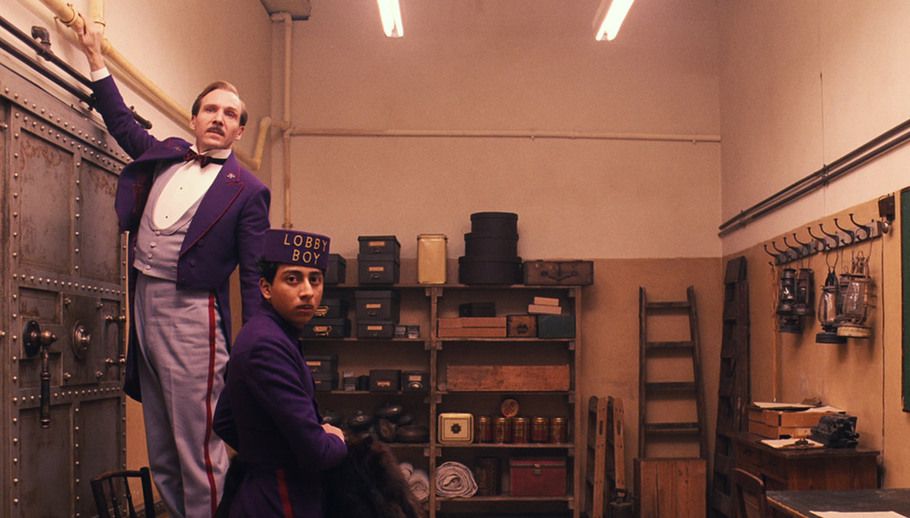
Grand Budapest Hotel (2014), dir. Wes Anderson

Whimsical, vibrant, and meticulously symmetrical, Grand Budapest Hotel tells the wild misadventures of M. Gustave H. (Ralph Fiennes), the titular hotel’s exceptional concierge, and his protégé, the lobby boy Zero Moustafa (Tony Revolori). Set in the snowy (and very fictional) Republic of Zubrowka during the 1930s, the two men’s story takes an unexpected turn when Madame D., a highly esteemed hotel guest, dies under mysterious circumstances. The events following her death plunge Gustave and Zero into a whirlwind quest that also comes to implicate Zero’s fiancée Agatha (Saoirse Ronan).
The film combines intertwining storylines and an engaging plot with impeccable cinematography. The snowy landscapes, the warm, pastel color palette, and the bittersweet sense of nostalgia settling everywhere across Anderson’s frame make Grand Budapest Hotel the perfect film to unwind with while staying in and cozying up.
My Night at Maud’s (1969), dir. Éric Rohmer

The fourth entry in Éric Rohmer’s Six Moral Tales, My Night at Maud’s follows Jean-Louis (Jean-Louis Trintignant), a devout Catholic engineer, on a Christmas visit to Clermont. During the trip, Jean-Louis reunites with his old friend Vidal (Antoine Vitez), and the quiet life he’s known and devoted to mathematics, philosophy, and attending mass on Sundays becomes irreversibly disrupted. Vidal introduces Jean-Louis to the beautiful, intriguing divorcee Maud (Françoise Fabian). Over the course of Christmas Eve, Jean-Louis and Maud engage in a lively conversation, discussing temptation, desire, and moral conflict and thereby severely complicating Jean-Louis’ religious idealism with the ethical questions attendant to real life.
The film’s stimulating dialogue launches us, too, into a rich, philosophical exploration of human relationships, while the striking black-and-white stills do a great deal to immerse us in Rohmer’s contemplative Christmas.
Edward Scissorhands (1990), dir. Tim Burton

Edward Scissorhands explores, at its core, the interplay between love and acceptance, individuality and conformity. It tells the enchanting story of Edward (Johnny Depp), an enigmatic humanoid born with scissors for hands. Despite his frightening appearance, Edward has a sensitive and gentle nature that gets a first proper chance at shining through when he meets Peg Boggs (Diane Wiest), an erudite woman who brings him along to her small, picturesque town and introduces him to her community. Quickly, everyone becomes fascinated by Edward, most of all Peg’s daughter, Kim (Winona Ryder), with whom he forms a deep connection. Kim and Edward’s relationship encapsulates his struggle to understand and express human emotions while attempting to fit into a world that doesn’t fully accept him.
The film is a classic, offering both a heartwarming story and beautiful aesthetics. Set around Christmas time in a snowy suburban landscape, the story teems with emotional warmth and just the right amount of holiday ambience, and cements Tim Burton’s bizarre and extravagant touch.
Little Women (2019), dir. Greta Gerwig

A modern interpretation of Louisa May Alcott’s classic novel, Greta Gerwig’s Little Women centers on the lives of the March sisters, each uniquely gifted and set on a distinct life path. Jo (Saoirse Ronan), the film’s semi-protagonist, is the most unconventionally independent of the four women — a passionate writer striving to balance her personal ambitions with societal expectations. Meg (Emma Watson), the eldest, seeks domesticity and its more traditional pleasures, while Amy (Florence Pugh), a painter, pursues her talents through strategic choices, determined to secure a prosperous future. The youngest sister, Beth (Eliza Scanlen), is quiet and graceful by nature, battling illness.
Written in 1868, the eponymous book’s sensitive and nuanced attention to the themes of female independence and ambition remains very relevant today, and Gerwig strikes the right note in her rendition of Alcott’s narrative tension between the external demands on women and their personal desires. Her storytelling is captivating, seamlessly moving back and forth in time to explore the sisters’ individual journeys and their shared bond as a family. Despite the occasionally heavy themes, Little Women succeeds in blending its powerful statements with the emotional warmth and feel-good energy that are distinctive of all essential holiday viewings. It is a sweet, impactful film.




Leave a comment