Has it really been a disappointing year for film? As 2024 draws to a close, it’s worth looking back at what many media outlets had predicted at the wake of the SAG-AFTRA strike in November of 2023, and many more have sought to confirm twelve months later: that this last calendar year produced both fewer films and more flops than usual. Among critics lamenting the overuse of AI and CGI effects, or showing issue with the medium’s flailing commercial appeal, there have been many voices this past year whose skepticism did not just pose a fleeting or merely contrarian gesture. Ian Wang’s recent piece on the industry’s hollow aestheticizations of real-world struggles and its simultaneous disavowal of any true political responsibility has been one such masterclass in critique, insofar as it didn’t merely point fingers at the big names of 2024, but also pointed towards a revised understanding of what filmmakers and critics alike could still strive to effect with their work. While it’s not my intention to take away from the necessity of correctives like Wang’s, I find it difficult to endorse their attendant conclusion about the failure of twelve whole months of cinema – it strikes me as too bleak. Among our contributors, the consensus has been that 2024 was a good year for film, and foreign-language film most of all. From Sundance and Berlinale standouts to later festival winners in Cannes and Locarno, our end-of-the-year selection aims to spotlight some of the superb films that were produced in the geographical, cultural and financial outskirts of blockbuster-land. As ever, you are invited to use the comment section below and let us know of your own film picks for 2024 and your most-awaited titles for the year ahead.
Panagiota Stoltidou
Click here for Part II of our 2024 reviews (in German).
Love Lies Bleeding, dir. Rose Glass

Muscle tissue. Sweat. Tears.
In this neo-noir romantic thriller, the body is pushed to its limits. Set in the 80s, somewhere in the American South West, the film follows Lou (Kristen Stewart), a lone gym manager who develops a fatal attraction to Jackie (Katy O’Brian), an ambitious bodybuilder with her head set on going to Vegas in pursuit of a dream. The raid bodybuilder comes to save Lou from the boredom of small-town life, and with this come big changes. As the two grow close, exploring each other’s bodies and becoming increasingly consumed by their relationship, the external starts to infiltrate the personal. The town has many secrets –bodies that have not been given justice– and the connections between previous crimes and their own begin to get intertwined when Lou’s family secrets come to light.
Sex and violence become choreography. Both are shown explicitly, and they slowly merge into the same category, as this high-intensity love finds itself in the backstory of a mystery. A close-up shot of a muscle flexing remains the same when used for an embrace between the two lovers, or as preparation to set another blow on a disfigured face that is interfering in their lives. The story spirals into more crimes, family secrets, and the cusp of consuming love; the body evolves and adapts to keep up. From Jackie’s steroid-modification of her own body to the mutilation of others in acts of revenge and protection, muscles become the vehicle of identity and violence.
A crushed skull. Bloodied knuckles. Deadpan eyes.
Anyone can feel strong hiding behind a piece of metal. I prefer to know my own strength, Jackie states. Indeed, as the pair fall in love, the corpses pile up. Blood becomes a symbol of the erotic, while the couple navigates their relationship.
A Thelma and Louise on steroids, this film doesn’t shy away from showing us what the body can do. With intense performances by Stewart and O’Brian, remarkable cinematography and the surreal tones driving the end of the story, the film reshapes itself into a new reality in order to give Lou and Jackie a space to be on their own.
Camilla Marchese Gonzalez
Crossing, dir. Levan Akin

Georgia. A determined aunt is looking for her niece. A young man is ready to help. Soon they’ll be sitting next to each other on the bus to Istanbul. Crossing offers us broad roads, hotel rooms and narrow streets, and a title to link everything together. Lia (Mzia Arabuli) and Achi (Lucas Kankava), the aunt and the boy, are crossing the border first, then the sea, just like Tekla, Lia’s niece, once did, or so they suppose: they are following her steps in the hope of finding her. What interests me, as a viewer, is the materiality of this quest: how searching – crossing – becomes the material of the film.
Two children are playing music, walking up and down the streets, asking for money. They eventually lead Lia and Achi to Evrim (Deniz Dumanli), whose path they’ve already crossed several times in the film, but never consciously, always in the background. Evrim is the one who makes us, in turn, cross the remaining spatial frontiers: through her we see the interiors of brothels and offices, the intimacy of kitchens and bedrooms… Tekla is closer than ever, yet the film focuses explicitly on everything that isn’t her. Achi escapes the suffocating bedroom he shares with Lia and dives into the city. There is a sun-flooded bakery after a night of partying and shiny green baklavas stuffed into mouths. Lia dances, and dances again. But if Istanbul produces, cinematographically, the material context of Tekla’s life, Tekla herself doesn’t materialize within it.
At the end of the film, Lia walks back to the port, where she will cross the Bosporus again. As her legs carry her down the stone path, her shoes meet other shoes. The camera pans up to the faces — she has finally reached Tekla. There is a scene where they are surreally sitting together, and as Lia arrives to the boat, alone, and embarks for the sea, Tekla is no longer there. She was never there. Yet Lia has found her. She has abolished the distance to her estranged niece, seeking refuge in the queer community of Istanbul, because she saw what she saw, went where she went, met whom she met: because she walked in Tekla’s shoes.
Emma Gresinski
The Substance, dir. Coralie Fargeat

“Have you ever dreamt of a better version of yourself? Younger, more beautiful, more perfect?”
In Coralie Fargeat’s newest body horror film, the recipient of this year’s Cannes Award for Best Screenplay, fading Hollywood star Elisabeth Sparkle (Demi Moore) loses her job as the hostess of a daytime television fitness show on her 50th birthday. The reasoning given to her by her producer (Dennis Quaid) is sparse and simple: they’re looking for someone younger to take over now. Soon after, Elisabeth gets a late night call from a mysterious dealer. He’s pitching the Substance, a new drug that promises to generate a younger, hotter-looking version of herself via a deceptively simple medical procedure. The instructions are also straightforward: Elizabeth and her younger self must take one-week turns being alive in order for the Substance to work. Desperate to remain young and relevant – if only for every other week – Elisabeth signs up. Her younger alter ego, the gorgeous and anatomically perfect Sue (Margaret Qualley), secures Elisabeth’s old job, and the two women get caught into a protracted game of aggression and hate, as they progressively misuse the substance to harm each other’s bodies. Yet it remains unclear who’s paying the physical price here: after all, Elizabeth and Sue seem to share a consciousness, and Elizabeth’s short calls with the Substance dealer after Sue’s recurrent drug misuse always end with his warning that the two women are, indeed, one. To harm the other means to harm oneself.
In a youth-obsessed society that attaches women’s value to their looks, The Substance shows the lengths that women – and aging women most of all – will go to to achieve the unrealistic beauty standards set for them. Yet what are the deeper implications of being willing to change your whole entire physical self in the pursuit of an inherited ideal? Coralie Fargeat uncovers the deeply misogynistic workings of the contemporary female self and leads them to a disturbing conclusion. The bright colours, fast camera movements and loud creaking sounds of her film create an audiovisual hyperbole that is as unsettling in its form as the plot is in its content.
Elena Patsalia
Anora, dir. Sean Baker

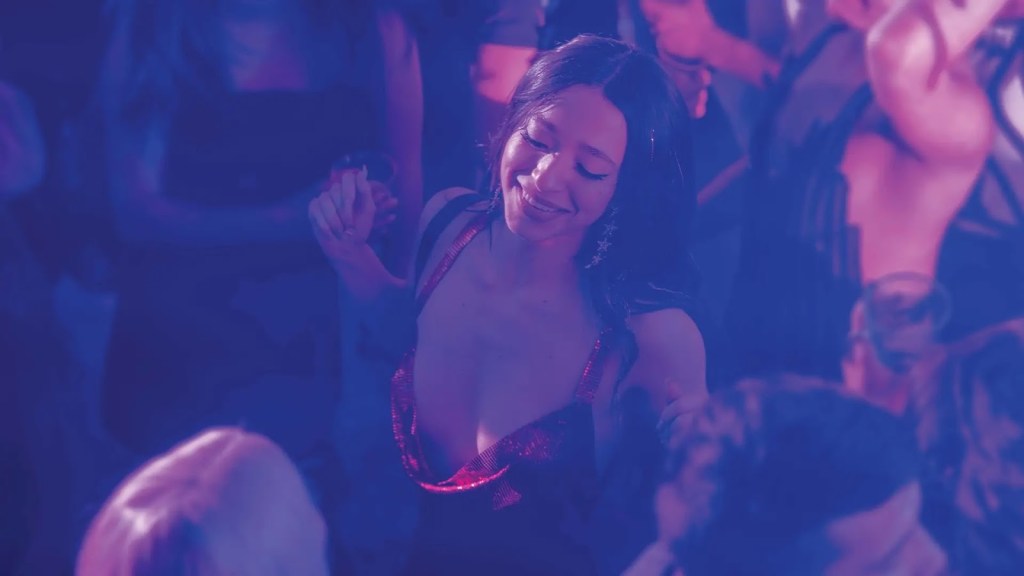
A testament to Sean Baker’s exceptional artistic sensitivity to the lives of people that make do on the margins of contemporary American society, this year’s Palme D’Or winner stars Mikey Madison in a career-making performance as the Russian-American Ani (short for “Anora”), an exotic dancer working in a Manhattan night club. It is there that Ani first meets Ivan (Mark Eydelshteyn), the spoiled and aloof son of a Russian oligarch who’s come to New York to study, but prefers to spend his family’s money on drugs and booze instead. As the only Russian-speaking dancer in the club, Ani is tasked with entertaining the expat, and he quickly makes her an offer she can’t refuse: she will be his “horny girlfriend” for a week; he will pay her 15.000$ in cash, upfront.
What ensues is extravagant, hilarious madness: reckless shopping sprees, almost-constant sex – there are obligatory intermissions for Ivan to play video games as Ani rests her head on his lap – and a preposterous weekend trip to Las Vegas. When Ivan asks Ani to marry him on a whim, her expressive eyes convey both joy and disbelief: is this really all it takes to escape the hustle? But this is Vegas, and Ani says yes. The affair is sealed with a three-carat diamond ring.
All the signs for what’s coming are there from the start. When Ani and Ivan half-nakedly debate the financial terms of their deal on the king-size bed of his parents’ Brooklyn mansion, it makes for a jarring glimpse at the transactional core of their bond. Yet Baker’s storytelling talents and Madison’s astounding ability to engineer our emotional investment in Ani’s fate perform the impressive balancing feat of revealing these fraught relationship dynamics without immediately ravaging their Cinderella-meets-Pretty Woman illusion. We need to believe that Ivan is nice, and so does Ani. Her decision to trust him is a defiant act of hope.
Of course, it’s not long before Ivan’s parents find out about his dancer wife and set their trio of local confidantes on the kids to get the marriage annulled. Ani won’t go down without a fight, and the film’s second half involves a lot of iconic one-liners and excellenty choreographed slapstick as she navigates the intruders. The comedic interlude is fun, and yet it cannot distract us for too long from the truth of Ani’s circumstances; if anything, it makes her final comedown feel all the more brutal.
Anora is, no doubt, a punch of a film that we see coming from a mile away. And yet we cannot help but take it to the face, eyes wide open. Baker insists that we look on: it’s the least we can do for Ani. By now we’ve come to love her as much as he, and she doesn’t walk away empty-handed.
Panagiota Stoltidou
Longlegs, dir. Oz Perkins

Longlegs isn’t a Christmas movie and yet, as the black-on-red opening credits fade into the cool, bluish hues of a snowscape, we are hit with the strong, eerie nostalgia of Christmases past. We can almost hear the sounds our footsteps would make atop the crisp, white snow – although, for now, we are sitting in the back of a car, pulling up to the yard of a little white house.
Enter a voyeuristic zoom to the little white house, in which a girl lives with her mother. The girl sits in front of her window, looking out to discover the parked car. It is an unexpected visitor. Yet – what with Longlegs being a non-Christmas movie – it’s not Santa visiting but a much less friendly spirit that, if denied entry, will put you on a kind of naughty list you would barter your soul not to be on. Soon after this dream-like flashback sequence, we are transported to the film’s 90s present, where FBI agent Lee Harker (played by scream queen Maika Monroe) attempts to catch the satanic serial killer of her childhood (played by a barely recognizable Nick Cage). She seems to have a spiritual connection to him, burrowed deep into her subconscious and half forgotten, but all the more powerful for it.
Not unlike our protagonist, who becomes controlled by a satanic totem-like doll, “telling her where to look and where not to look,” we too are being controlled in Longlegs, our gaze forcefully directed by its strong aesthetic language. As the plot remains ominous all throughout, the movie is all the more pleasing to the synesthetic mind: it’s “style over substance” at its best, while the substance on display here is largely referential, feeding off an intersection between true crime, Satanism, the horror genre and rock and roll – specifically the band T. Rex, who are quoted in the opening credits and to whom the movie owes its birth in a way that is, just like Longlegs itself, easier to “feel” than to explain.
“Think of it like playing a piano: If the left hand is playing the plot, the right hand is playing the soul,” director Oz Perkins is quoted saying about his latest film in Rolling Stone magazine. He continues: “The right hand is playing the spirit. The right hand is playing the art, the mystery, the wonder, the curiosity, the beauty, the glamor. So, I’d say that the T. Rex stuff had nothing to do with the plot — but everything to do with the vibe.”
My advice: If you overuse the term “vibe”, like rock music, read Stephen King and/or repost film stills on tumblr, Longlegs is the movie for you.
Una Kuon

Leave a comment