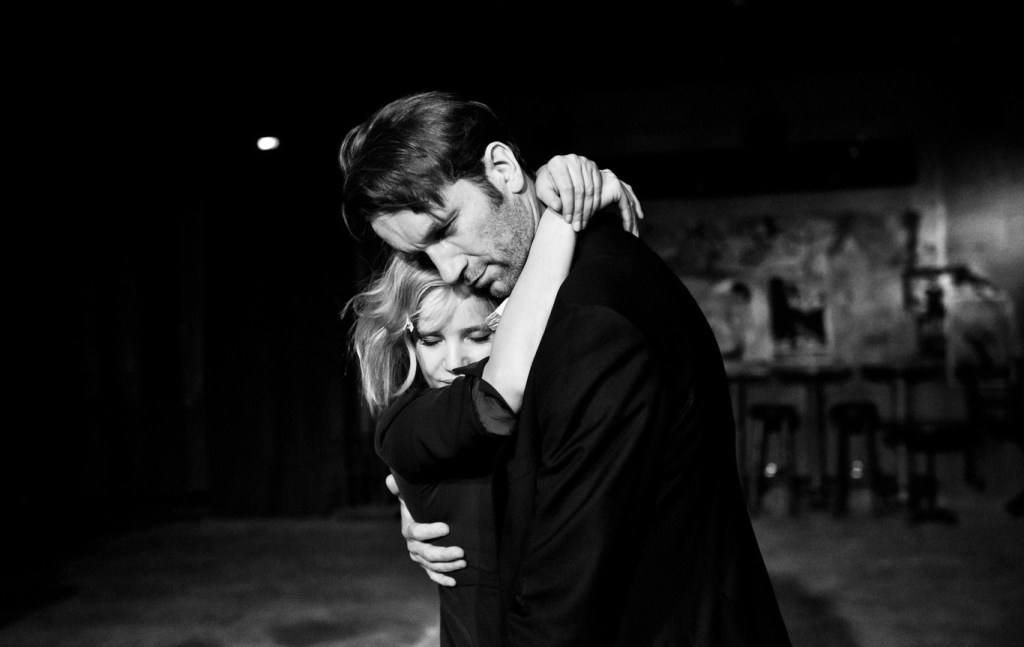
In Pawel Pawlikowski’s Cold War (2018), music maps out the historical and ideological transformations that two lovers face.
An essay by Camilla Marchese Gonzalez
The score consumes and illuminates the black-and-white screen in Cold War. It includes a diverse catalogue from Polish folklore to jazz that is both catalyst and witness of the tragic romance between Wiktor (Tomasz Kot), a prominent musician and composer, and singer Zula (Joanna Kulig). Cold War begins in the ruins of a Polish Church in which the lovers find themselves again after migrating geographically and ideologically, between the East and West, in the span of 15 years. The music follows the characters as they navigate their relationship and careers from both sides of the Iron Curtain. It becomes an audiovisual map of the sociopolitical and private changes they undergo, alone or in tandem. Music unites them in the first place, when Zula is recruited to join Mazurek, the Polish folk music group Wiktor helped to cast. There, their relationship slowly evolves from conductor and singer to lovers. Pawlikowski documents the traditional costumes, dances and tunes from rural Poland and aptly captures the characters’ ethnographic mission at the beginning of their love.
At the same time, however, the score is not a static element of the story. It is a shape-shifting force that evolves, as socio-political realities come to infiltrate the lovers’ personal lives. It parallels Wiktor and Zula’s movements from Poland to Paris, in different timelines and places, back and forth, as the Cold War becomes the inescapable backdrop of the melody of their love and they try – and fail – to be together. The most prominent example of music’s salient narrativity in the film lies in the transformation of the recurring song “Dwa serduszka.” Pawlikowski offers different versions of the song, with each one fitting into a specific moment of the story. Initially, the song is situated in a folklore context. It is first introduced when Wiktor and his colleague Irena (Agata Kulesza) are casting talent as music ethnographers. The song is performed by a young girl, lost within the multiple casting shots in the preparation of the folklore music ensemble. Then, the audience is immersed back into this song through the Mazurek group’s first public performance in Warsaw in 1951.
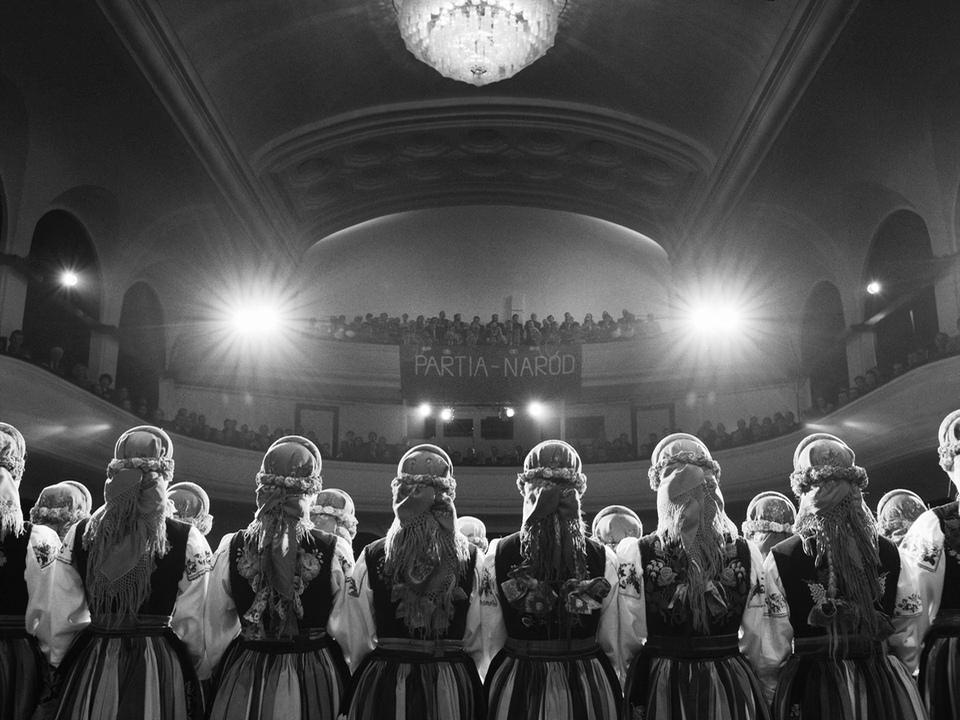
In this second performance, music symbolizes the idea of the collective. Although it focuses on Wiktor and Zula, the scene follows the entire music ensemble: it simultaneously depicts a collective body of singers occupying the stage, as well as the directors backstage and the audience. Zula performs in the center of the group, but the close up shot of her gracefully projecting the traditional tune pans out to show the entirety of her collaborators. This mirrors the downgrade that Mazurek’s music suffers after the “Stalinization”’ of the genre, in which folklore music is corrupted and reshaped into propagandistic performances.

In the second half of the film, set in the West, music reflects the ideological shifts that the protagonists undergo in their private lives. The story revisits the song as part of a piano improvisation by Wiktor, who has now decided to cross to the West as a soon-to-be musician in a Parisian jazz club. The modification is subtle here, and yet it foreshadows the assimilation that Wiktor experiences as he attempts to fit into the Parisian socialite scene. His new relationship to “Dwa serduszka” is succinctly juxtaposed to that of Zula, when she visits him after her marriage to an Italian man – a circumstance that allowed her to legally migrate abroad. The camera portrays Zula performing the same song, their song, in the Parisian jazz club. Her soothing voice captivates the Parisians’ attention: she performs in the center and the shot is absorbed by her presence, just as it did in the Mazurek performance scene. The camera pans in 180 degrees until we see Wiktor, his skillful hands playing the piano, glancing and smiling at the mesmerizing singer, as the roar of the audience’s claps take over the last words of the song. As portrayed in this scene, Zula performs the song in its original format, in Polish, naturally and confidently.
Later on, Viktor urges Zula to perform a French translation of the song. This is where the ideological distinction between the characters becomes fully fleshed out through music. He tries to translate the song, just as he did his relationship, into the bourgeois Parisian setting he so eagerly tried to immerse himself in: “it fits when you pronounce it correctly.” But for all his efforts, he is unable to make her fit properly. Zula resists. Wiktor sees their French record as an opportunity while Zula sees it as a “bastard,” despising the way he wants her to change in order to fit in, but more importantly, how he has changed himself already. They find themselves in opposite perspectives on how they portray and maintain their Polish identity, and their unofficial love song is the backdrop of this realization.
This Parisian period becomes an ex negativo reflection on where they could be as a couple if the Cold War had not infiltrated their lives. It is momentary as a keynote, but the possibility lingers as the audience can’t help but wonder how their relationship would have developed had they both stayed on the same side of the Iron Curtain. The song, which is a clever and effective motif to track the characters’ timeline, is subtle, almost unnoticeable on a first viewing. In the space of the screen, it shadows without overshadowing, quietly exposing how the grand narrative of the Cold War colonizes the characters’ relationship.
Ultimately, the sacrifices that Wiktor and Zula make in order to be together come to define the fate of their musical careers. Wiktor gets mutilated –never to play music again– in a Polish work camp after trying to go back to the East and Zula. She marries off as a trade to bail him out and turns into a propaganda performer of cheesy Socialist songs, drunk and miserable. Their music careers and relationship have become collateral damage of the war they lived through. Nevertheless, they encounter each other again in the deserted ruins of the church seen when the story began. “Let’s go to the other side, the view will be better there,” Zula says before the two disappear from the screen, and the audience is surrounded by nothing but a silence that becomes at once deafening and liberating. Music has become the unspoken language between them, and one that is now shared with the audience. It is what unites Wiktor and Zula from the start and what fills up the final silence between them. Or, to end with Pawlikowski: it “is the color in [this] black and white film.”


Leave a comment