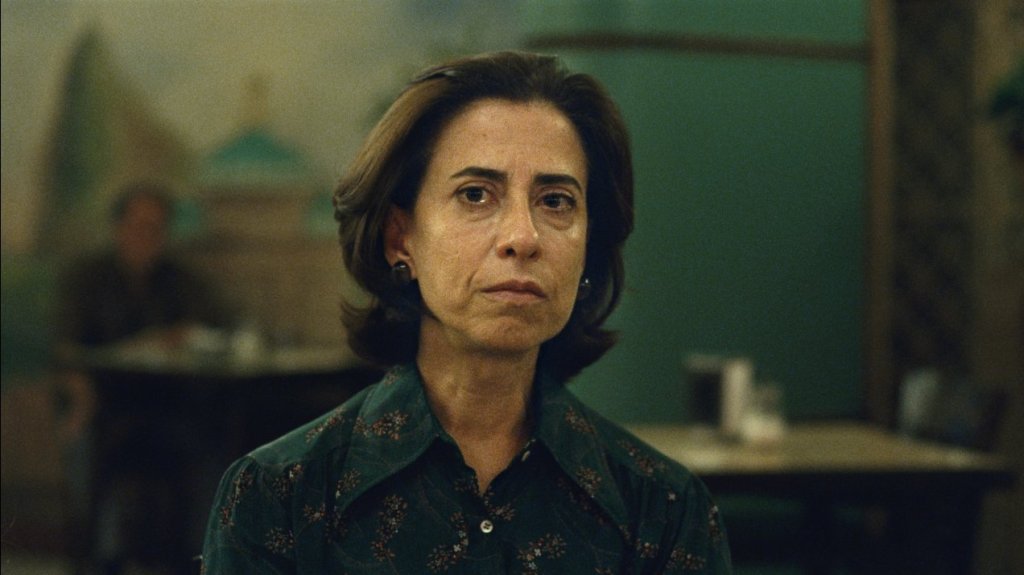
Amidst the faceless violence of the military dictatorship, Fernanda Torres raises Brazilian cinema to new heights.
A review by Francesco Fritz
After an endless two-month wait I’m Still Here (Ainda estou aqui) has finally reached Europe, the US, and will soon make it to much of Latin America too. It’s not often that a movie is already so celebrated before much of the global public has even seen it: best screenplay at the Venice film festival last September, and then a sudden box office hit in its home country Brazil after a late release in November. Ever since then, it has won Fernanda Torres the first Brazilian Golden Globe in an acting category and is a likely contender for an Academy Award in March.
At first glance, the movie’s premise seems ripe for Oscar-bait. The idyllic upper-class life of a large Rio de Janeiro family is derailed when its patriarch Rubens Paiva (Selton Mello), an ex-leftwing congressman, gets arrested at the height of the military dictatorship; his wife Eunice (Fernanda Torres) then spends much of the movie fighting for his liberation while wading her children through the hostility of the authorities. It is often the case that this kind of biographical setup falls into the same cookie-cutter patterns, where flat dramatic elements serve exclusively the sanctification of the heroic and martyrial protagonist.

However, Central Station director Walter Salles –who also has producer credits for the legendary 2002 film City of God– takes a different path in his latest feature. The first twenty minutes of saccharine family joy in I’m Still Here are, by all means, somewhat trite. Yet from the moment the father disappears, silence and muted colors wash over the audience, and the stage is handed to Fernanda Torres’ incredible performance. Instead of the macabre scenes of police torture and nervous breakdowns typical for this genre, the movie proceeds with restraint. Torres moves through much of it in contained turmoil, ever so slightly shivering during a police interrogation, moving firmly around friends who are unable to help her, and laying a veil of kind smiles and reassuring words over the daily lives of her five children. With any actress less able this might have all fallen flat. Instead, Torres performs the impossible feat of letting anger, grief, and grim determination tremble a mere degree away from an all-out explosion. This holds up until the film’s very end, when Eunice is 85 and ill with Alzheimer’s. Here it’s Fernanda Montenegro, another legendary Brazilian actress and Torres’ real-life mother, who sits in front of the TV news report. A picture of her deceased husband is shown while her unfocused, absent gaze lights up for a moment, grows wide, and then dim again.
As was to be expected, Salles’ movie drew criticism in Brazil from rightwing nostalgics, who called for its boycott. But the left also criticized the film for its one-sided attention to the dictatorship’s impact on Rio’s white upper-class. While there’s merit in this latter point, the movie adds an important new layer to the often simplistic perception of the country beyond its own borders. For two decades the main cinematic association with Brazil has been that of violent favelas in City of God (2002), and more recently rural abandonment in Bacurau (2019). In I’m Still Here we witness a complex urban struggle against an abject military dictatorship that offers both a new image of Brazil to the world and, if nothing else, an incomparable performance by Fernanda Torres.






Leave a comment