In Luca Guadagnino’s most personal film to date, the pleasures and pitfalls of a relationship are exposed in their sensual and heartbreaking rawness.
A review by Iliana Tsachpini
After the delayed release of Challengers, the highly anticipated Queer (2024) has now also reached the big screen. The second installment in Guadagnino and writer Justin Kuritzkes’ unintentional double feature explores the themes of desire, lust, love and intimacy, all through the lens of queerness. Queer premiered in the Competition of the 81st Venice Film Festival and is an adaptation of William S. Burroughs’ eponymous novella, written in the early 50s but only published posthumously in 1985 due to its controversial themes.
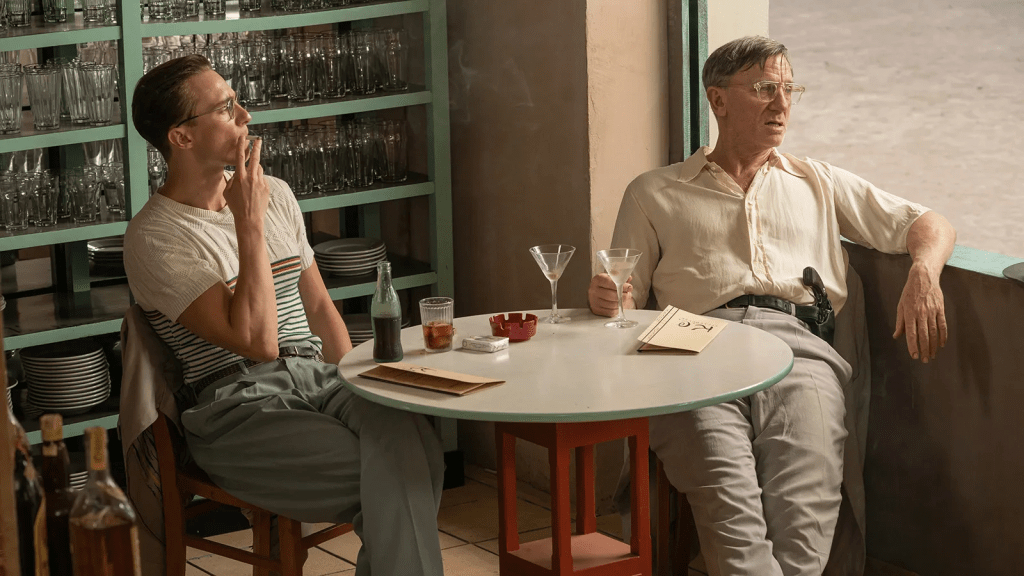
The story follows William Lee (Daniel Craig), an American expat whose life is consumed by nights out, heavy drinking, and a severe heroin addiction. He strives to maintain a polished look, donning white linen suits and faking indifference to his crumbling reality. Yet his permanently messy hair and damp forehead tell a different story. While strolling the streets of an almost artificial-looking Mexico City, Lee’s gaze —and then, his heart— is captured by Eugene Allerton (Drew Starkey), a flawless but enigmatic young man, beautiful even under the sweltering heat. Eugene spends countless hours with Lee —bar hopping, going to the cinema, discussing sexual escapades— but his sexuality remains ambiguous. Occasionally, he leaves Lee to play chess with Mary (Andra Ursuta), though the nature of his connection to her is unclear.

As expected, the inevitable happens: Lee invites Eugene to his apartment, and by the end of the night, they are in bed together. Guadagnino spares no details, much like he did in the romantic queer drama Call Me by Your Name (2017), though the sexual content here is far more explicit. Perhaps also inevitably, Eugene becomes even more unavailable after the intimate encounter. He withdraws further as Lee grows more desperate. Eventually, Lee reaches the point of proposing that the two escape to South America on his expense, in search of yagé, a rare drug found in the jungle that enhances telepathy qualities. In return, Eugene has to be “nice to him, say, twice a week?”
Telepathy becomes a key theme in this film. Alongside a poignant soundtrack, we often watch a translucent form emerge from Lee’s body, acting out the desires he cannot express, and turning his unspoken thoughts and longing into a desperate, telepathic reach for Eugene. During their trip to South America, Lee’s obsession with finding yagé is set against his physical withdrawal from heroin. The line between dream and reality blurs, as William’s dreams become increasingly feverish, laced with desire and paranoia. Eventually, he satiates his addiction with what it wants most: yagé. But despite his hopes, not even that can make Eugene see and desire Lee as he would like to be seen and desired by him.

Queer is a film about addiction. Substance addiction, yes—but more than that, it’s about a man who is addicted to the very state of addiction itself. Above everything, Lee is addicted to another person. He twists himself inside out, reshapes his entire personality and suppresses his own desires so that he may catch a mere fragment of Eugene’s affection. But no matter how desperately he tries to make Eugene love him in the same way, it’s impossible. And no amount of telepathy could offer a satisfying explanation for why this is so.
The first half of the film is filled with uncomfortable moments of secondhand embarrassment—mostly due to Daniel Craig’s incredible performance, but also because the narrative feels quite disoriented by various stylistic choices. Luca Guadagnino first read the novel at 17, and this film feels like a personal dialogue between his past and present self. It’s a mix of nostalgic reverence and artistic experimentation that could sometimes seem to carry more meaning for its creator than for its audience.


Leave a comment