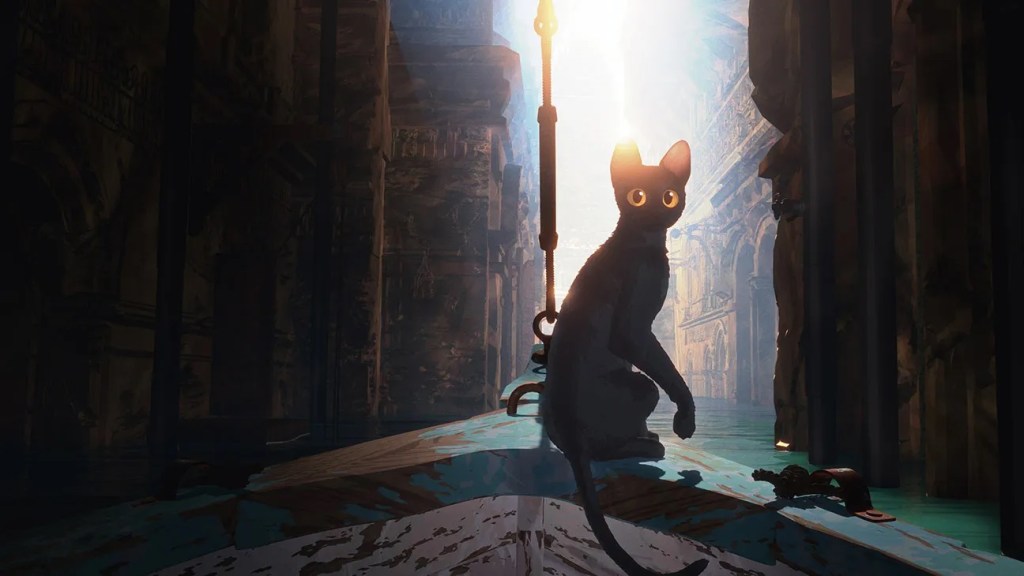
Coming out of the deep blue, this breathtaking animated tale from Latvian filmmaker Gints Zilbalodis shares its universal message with a unique perspective and not a single spoken word.
A review by Angeliki Dekavala
It is very rare that an independent animation film gathers the same amount of enthusiasm from kids, adults, critics and the industry alike, but Flow achieves just that. Using no spoken words at all, director Gints Zilbalodis succeeds in giving the audience a universal and intense experience. Premiering at last year’s Cannes, his film has enjoyed an exceptional course since, with wins at the Annecy International Animated Film Festival (Best Original Music, Jury Award, Audience Award) and the Golden Globes (Best Animated Picture). It is now a serious animation contender for the 97th Academy Awards in March.

Flow has the structure of a modern epic. It follows a cat who lives in perfect harmony with its solitary nature up until a big environmental catastrophe strikes. Now the cat is called to adapt in order to survive, teaming up with a capybara who has its own old boat. The sea journey begins. In their travels, the cat and the capybara find more lone animals that have been left behind by their own kind. First to join them is a ring-tailed lemur who has been gathering all sorts of trinkets. Later that same day they are also joined by a Labrador, whom the cat had encountered previously along with a pack of dogs, but who’s now been left to roam the land alone. When the company gets attacked by a flock of secretary birds who consider them a threat, it finds an unlikely savior in one of the younger birds, who abandons his own to defend them instead. Paying the price of a broken wing, the bird ends up joining the group as a worthy companion. In the next few days, the boat fills up with all sorts of other animals desperate to survive.
Zilbalodis’s tale of a solitary hero who travels the world in a boat and is doomed never to return back to its homeland reminded me a lot of Homer’s Odysseus. Both heroes’ journeys are catalyzed by external powers beyond their control, whether it’s the Greek gods or a supernatural flood. Both Odysseus and the cat are called to overcome their fears, act clever and adapt to surpass the difficulties that their journey holds and make it back on land. There is a scene in the film where the animals are sailing through a sunken city and their passage is really narrow and maze-like that reminded me ever so slightly of Homer’s Scylla and Charybdis chapter, in which Odysseus’s ship must sail between a legendary monster and a whirlpool. It is not often that we encounter a classic structure with such a fresh take to it, but Zilbalodis does just that.
Crucially, the film revolves heavily around the environment and the non-human animals that inhabit it. During the journey, we see a world empty of humans, filled only with the remains of civilizations past. The modern house with the wood carvings seen at the beginning of the adventure, the flooded temple where the lemur joins, the flooded city, the pillars that also bear carvings and roads all attest to a human presence that is long gone. Did the flood follow this absence, or is it rather responsible for it? The audience can only speculate, since the story is unfolding from the cat’s point of view and this does not have any answers to give. Here, Zilbalodis’s conscious choice to decenter humans and focus on animals is a brilliant act of defiance, and it gains added force at a time when the very real and very grave realities of global warming and environmental catastrophes are consistently challenged and pushed aside by the authorities that are supposed to tackle them. Flow’s message rings loud and clear: the world does not and should not revolve around us.

Beside its alternative focus on flora and fauna, the storytelling and world building also work nicely toward getting the film’s environmental messages across. Using minimal, so-called environmental storytelling, Flow plays around with cinema’s age-old saying —“show, don’t tell”— in offering constant visual hints about how its nonhuman world works. Through a confident visual and aural language, including animal expressions, body movements, and sounds, as well as through a lively and colorful animation, the film achieves great wordless communication that is at once straightforward and layered, deep. It should not come as a surprise that the director and sound engineers were very insistent on using real animal sounds. What is more, all of the different characters have their own, unique personality: the capybara is calm, the lemur is a quite self-absorbed collector, the cat is more collected and subtle, revering and forming a deep connection with the secretary bird, while the dogs are a bit mindless and playful. This is a film that takes its world and animals seriously, and treats them lovingly. Ultimately, and unlike the Odyssey, an epic journey whose many hardships are set off by human hubris, Flow’s comparable sea adventure is full of tenderness, and teaches us how to find comfort in chosen families. Its many different lessons on life and filmmaking all point toward an understanding of solidarity as the crucial solution to overcoming the problems and fears that overpower us when we face them on our own. This is a message full of hope, one that any living creature on earth could relate to.




Leave a comment