The results are in from our year-end poll of Filmpost contributors, and what a year it’s been! Before the clock strikes midnight, we look back on the best and brightest releases of 2025. From festival award-winners and box-office hits to indie gems and critics’ darlings, our picks have a finger on the pulse of a cinematic output as varied in narrative approach and technical innovation as it was surprisingly unified in some of its motifs. Read on and you’ll encounter more than one family finding catharsis in art; several nods to a certain 16th-century playwright; and, more uncannily still, a handful of houses haunted by cross-generational trauma. These —and other— subterranean connections add extra charm to a year in film that’s proven richer and more thrilling than any other in recent memory. Without further ado, here are, in no specific order, our favorite movies of 2025.
Panagiota Stoltidou
Click here for part two of our poll (in German).
Sorry, Baby, dir. Eva Victor
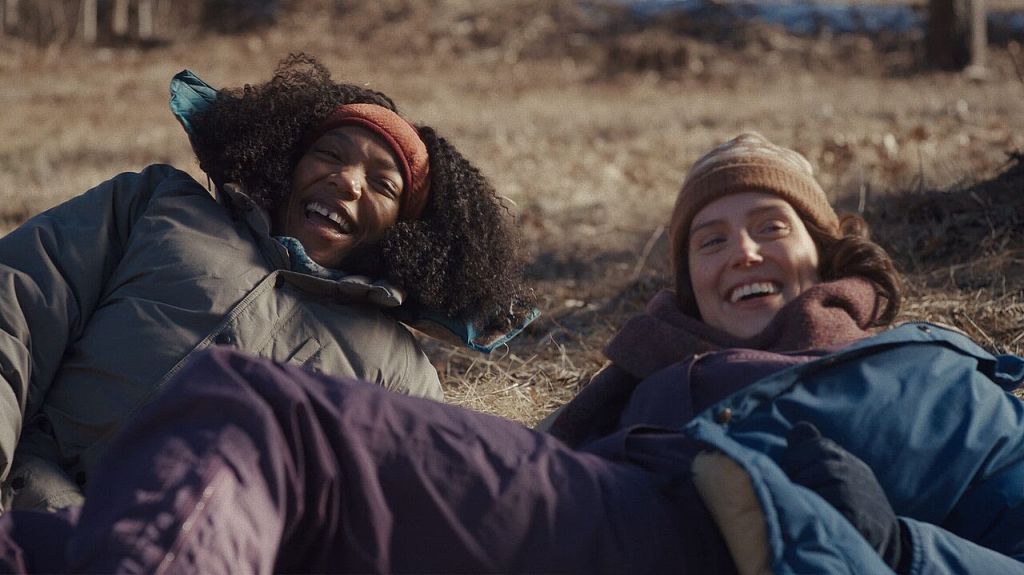
The Year with the Baby.
The Year with the Bad Thing.
The Year with the Questions.
The Year with the Good Sandwich.
This is how writer-director Eva Victor organizes the life of their protagonist, Agnes, whom they also portray. A graduate student-turned-assistant professor of literature in a New England college, Agnes spends her time either teaching or at home, on the outskirts of the town where she’s been living for most of her twenties. It’s a quiet existence, but not a peaceful one; the film’s four non-linear chapters map out a timeline bent and held together by a terrible incident. The specifics of this are only revealed midway through the film, and acquire their horrible shape less through direct depiction than through oral recreation, when Agnes recounts what’s happened to Lydie (Naomi Ackie), her best friend and roommate. It’s an all-too-familiar story, and we don’t really need to see much to guess at the extent of the terror. If anything, the picture Victor paints is all the more jarring for its narrative economy: Agnes walks into the house of Preston Decker (Louis Cancelmi), her mentor, and takes off her shoes. The facade of the house is lit from inside, as the day fades into night. For the longest time, nothing shifts except for the light. Then Agnes walks out, shoes in hand. She sits down on the front steps, then hastily puts on her shoes, stands up and runs off. And that’s it. That’s all.
While we are barred full access to that fateful night, we are given total insight into its aftermath in Agnes’s life. The bad thing, as she calls it, is like a black hole into which all life is sucked for quite some time. When Lydie tells Agnes that she’s expecting a child with her partner, Agnes’s reaction is one of joy mixed with horror—what will happen to her now that her best friend will become a mother? Emotional and physical intimacy are hard to navigate, even with someone as soft and caring as her new neighbor-turned-lover Gavin (Lucas Hedges). Agnes’s new office is the one that once bore Decker’s name on its door.
While the film doesn’t shy away from exposing all the parts that still hurt, Victor chooses to imbue Agnes’s relationship to her lingering trauma with a very unsentimental, at times even humorous sensibility. We keep seeing Agnes live her life as best she can, despite what’s happened. She’s neither being victimised nor portrayed as a “strong, independent fighter”; she simply exists in her body. For this body, it’s the small, plain things —a good sandwich, the attention given by a stray cat— that make a difference, and help Agnes process and eventually make peace with her tragedy. This is where the film’s true strength lies. In having life go on, whether we like it or not. In showing how the worlds we create around us can both ground and drown us, depending on our focus. Eva Victor chooses to shape a world where both the good and the bad are aplenty; and yet it is the good that ultimately stays with Agnes, and with us.
Angeliki Dekavala
Die My Love, dir. Lynne Ramsay
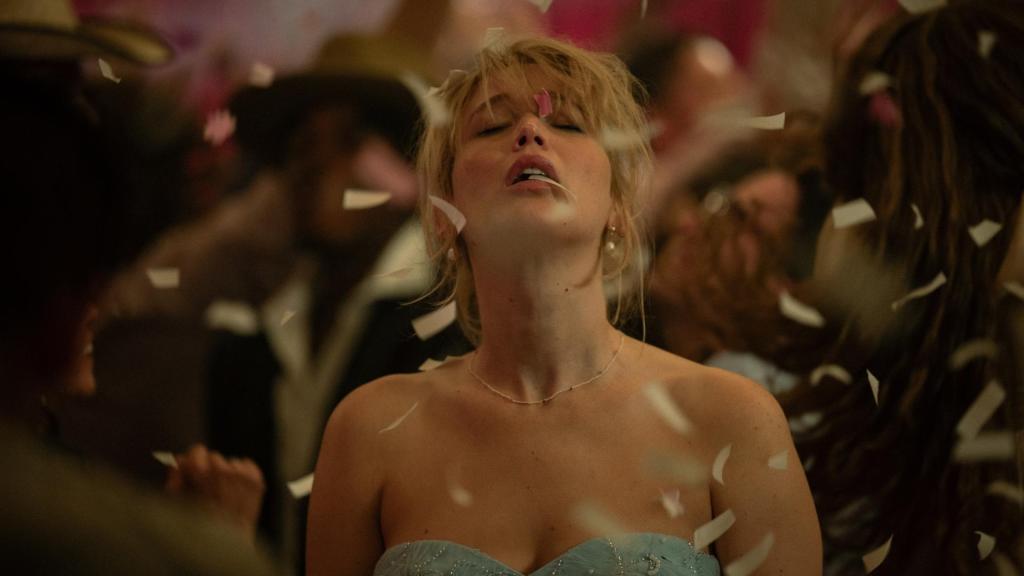
“What is the cost of having it all?”
Die My Love follows Grace (Jennifer Lawrence) and Jackson (Robert Pattinson), a young, passionate couple who leave New York for an isolated ranch in rural Montana, in search of a quieter dailiness. But the moment their baby arrives, everything starts falling apart. And that vast, picturesque landscape becomes Grace’s trap.
The film’s fragmented structure keeps us constantly off balance; nothing is as it seems. We are never offered the truth one hundred percent. Instead, we see Grace’s erratic and sometimes violent impulses, her compulsive affair with a stranger, and a deeply disturbing act involving the family dog. Threaded through it all is her internal refrain: “I am stuck between wanting to do something and not wanting to do anything.” This line captures Grace’s core tragedy: the paralysis of erasure, the feeling of becoming an invisible presence in her own life, losing part of a self that she knows will never return.
Lynne Ramsay refuses to frame Grace’s descent as a clinical case of postpartum depression. Instead, she delivers it as a psychological rupture: a loneliness so intense it feels bodily, a sexual frustration that rots into anger, and the unbearable, suffocating realization that Grace no longer occupies the center of her own life. The baby is the new gravity, while the woman who bore him is now only an afterthought.
The film strips away the romantic veneer of marriage and motherhood, exposing a brutal truth: love is not the solution. Jackson tries desperately to fix appearances: cleaning and remodeling the house, and then committing Grace to an institution. Yet this is an internal inferno. Jackson’s love is not a shield, but a suffocating pressure that ultimately compels Grace toward the final, devastating act of self-preservation.
This is not a film for everyone.
Joelle Habib
The Secret Agent, dir. Kleber Mendonça Filho

The latest feature by revolutionary Brazilian filmmaker Kleber Mendonça Filho, The Secret Agent (O Agente Secreto) becomes an exploration of memory, past and place. Set in the 1970s, in the final years of Brazil’s military dictatorship, this political thriller follows Marcelo/Armando (Wagner Moura), a widowed academic who returns to his hometown of Recife during carnival to reunite with his son as he plans their exile. He adopts a new identity and starts a new job while living in a communal dwelling alongside other political refugees. “To a better Brazil, with less mischief,” Marcelo and the fellow refugees toast in one of the only moments they are all together. They all find themselves to be collateral damage of conspiracy, political oppression and corruption in the game between Power and the People.
Carnival and death. Joy and fear. With a complex, multifaceted structure and tone, The Secret Agent explores Brazil’s complicated relationship with its political memory. The specter of the dictatorship is a constant, looming presence in the film, via zoom shots on the frames of Ernesto Gesiel, which are hung in virtually every room. For all its moments of dark humor, its entertaining, meandering plot and the compelling images by Evgenia Alexandrova, the film also bespeaks a deep, embodied understanding of everyday life under the colonels’ dictatorship. This is shown to be nothing short of a dance between survival and resistance. From Marcelo and his fellow dwellers in the refugees’ house to the film’s background characters, no life is lived without constant awareness of the threat that could disrupt it at any given moment.
The past and present converge in really fascinating ways in the film, which becomes almost self-aware of cinema’s role as archivist of history. As quoted in Mendonça Filho’s essay film Pictures of Ghosts (2023): “fiction films are the best documentaries.” The film shows fictional scars with the goal of uncovering a very real truth about Brazil’s recent past. With a swift click of a recording machine, the story flashes forward where, suddenly, we now hear Marcelo’s voice through muffled headphones. Two girls are working with the archives of his life, exploring what evidence is left of him. This mirrors Marcelo’s own quest to find information about his late mother in Recife’s social registration archive. Everyone is on a quest for the truth, yet this is hard to find in a country that’s been so intent on destroying it.
This year’s most awarded film at Cannes was electrifying, and left the small theater where I watched it in Woodstock, NY energized—not only through its outstanding score, cinematography and plot, but also through a message that lingers. Can historical fiction help us through a current moment whose political climate echoes the authoritarian ghosts of times past? The film accomplishes its purpose of documenting history for audiences of today and tomorrow.
Camilla Marchese Gonzalez
Sentimental Value, dir. Joachim Trier
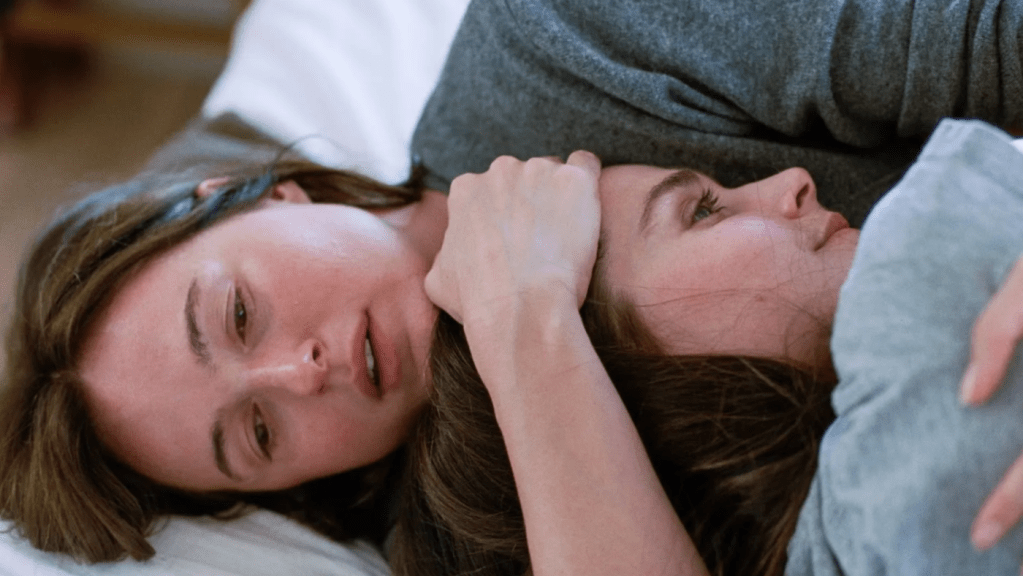
Known as the film that dethroned the notorious brat summer, Joachim Trier’s Sentimental Value was arguably one of the most talked-about films of the year, first gaining momentum at the 78th Cannes Film Festival, where it won the Grand Prix award. Starring an impeccable Renate Reinsve as the fiery and gifted Nora, Sentimental Value paints a family portrait shaped by absence and miscommunication, in which true sentiment remains a fragile, almost unreachable possibility.
After their mother’s death, Nora and her younger sister Agnes (Inga Ibsdotter Lilleaas) reunite in their childhood home. As they declutter their mother’s belongings, deciding what to keep before selling the property, they’re confronted with the comeback of their absent father, Gustav Borg (Stellan Skarsgård). A fading director, Gustav is attempting to relive his former days of professional glory with a fictionalized account of his mother’s life, to be shot in the very home that shaped not only his own childhood, but that of his daughters as well. He wants Nora, by now a well-known stage actor, to star in the film. What seems to elude him is that his abandonment of his family in this very home has left a trauma no film – his or anyone else’s – can hope to mend.
When Nora angrily refuses to collaborate, the part goes to hotshot American actress Rachel Kemp (Elle Fanning), who falls victim to Gustav’s charm at a film festival. With her talent and international fame comes funding, but under conditions: the director’s cherished project turns into a marketable Netflix production. Trier doesn’t miss the opportunity to hint at the ways profitability can overshadow creativity; at how the commercial can distort the personal.
Gustav’s return to the house and to his daughters’ lives releases an outburst of emotions: both sisters, each restrained in her intensity of expression, are faced with a trauma that stretches far back, yet only now resurfaces with urgent insistence. Nora is confronted with her avoidant relationship building and anxiety attacks; Agnes assumes the role of observer and mediator, yet can’t help but lose her temper too once in a while. The emotional tension is amplified through the house, which takes on a protagonistic role in the family’s unraveling and, in a way, reflects it. It bears a crack from the beginning, one that cannot be mended. And much like their home, Nora and Agnes’ relationship with their father is flawed to its core. Trier’s nuanced storytelling is impressive — we feel as though we have lived in this home and known all of its inhabitants in every state. At the same time, they remain distant ghosts of the past, and we’re left only with fragments to piece them back together.
Ultimately, Sentimental Value invites us to discover all the ways in which the past still lingers in our lives. To do so is painful, and yet there is, indeed, value in the process. While I wouldn’t claim this to be a perfect film, it is one that profoundly captures our human essence.
Iliana Tsachpini
Hamnet, dir. Chloé Zhao
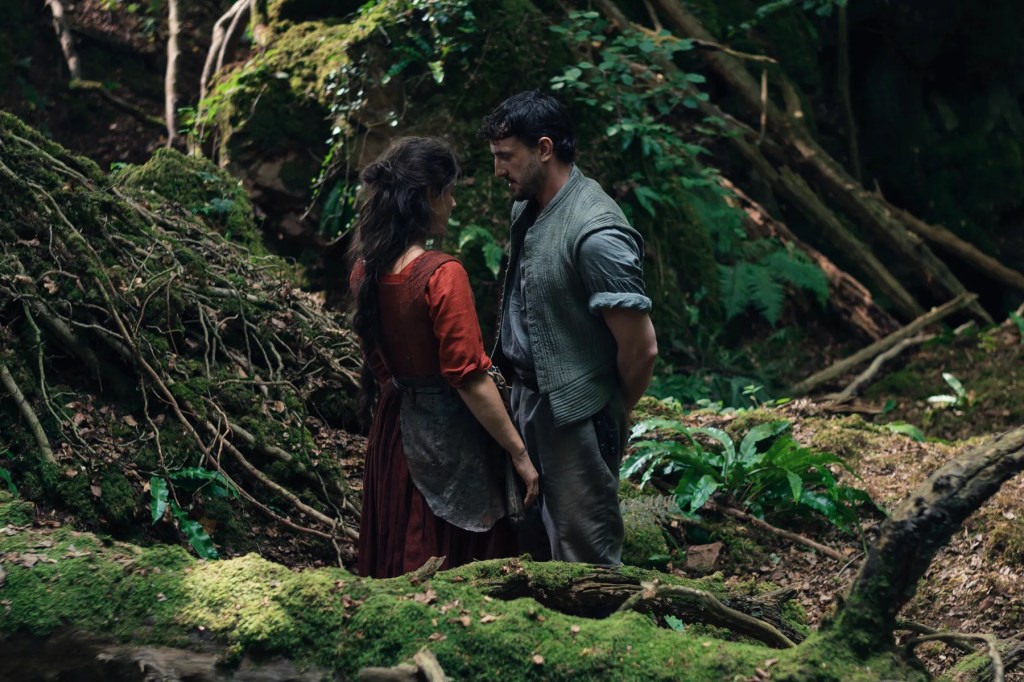
When we first see Agnes (Jessie Buckley), she’s curled up on a forest floor in rural England, a spot of burgundy fabric upon an expanse of green. For some moments, her sleeping body’s so enmeshed in its surroundings, so still, that there is a sense of disbelief when she finally wakes up and makes her way out of the woods. Agnes’s deep connection to nature has not gone unnoticed among her townspeople; it’s the 1500s, and word’s been getting around that she’s a witch. It doesn’t help that she’s never once seen without her falcon, or that she possesses a prodigious knowledge of medicinal herbs. Yet it’s precisely Agnes’s eccentricities that attract Will (Paul Mescal), her brothers’ new Latin tutor.
Will is, it turns out, none other than William Shakespeare, the English playwright of near-unmatched literary fame whose works have gone down in history as some of the best ever to be written. Agnes, better known as Anne Hathaway, is the woman he will marry. For those familiar with the Bard’s biography, Chloé Zhao’s latest film offers no narrative surprises. All that is known is there, from Will and Agnes’s courtship and the birth of their three children to the death of their only son, Hamnet (Jakobi Jupe), at the age of eleven. What surprises, instead, is Zhao’s ambitious framing. Adapted from Maggie O’Farrell’s bestselling 2020 novel, Hamnet assembles the scant facts of Shakespeare’s life into the intimate tale of a family pulled apart by unimaginable loss, and then brought back together through art. In O’Farrell’s and now Zhao’s imagining, Shakespeare’s play Hamlet is what became of the real-life tragedy of losing Hamnet—the great auteur’s means to both honor and let go of his son.
It’s a fascinating, if factually tenuous, conjecture. To be sure, the names “Hamnet” and “Hamlet” were used interchangeably in Shakespeare’s time, as the film’s epigraph tells us. And yes, the play did premiere shortly after Hamnet’s death. But this is as far as historical hints go. To ground its premise, Zhao’s speculative fiction seeks evidence elsewhere, in a place less conventional, perhaps, but no less capable of truth: the work itself. Hamlet —the story of a Danish prince caught in the aftermath of his father’s death— couldn’t be farther from the specifics of the Shakespeares’ own experience of loss; yet in the film’s devastating finale, when the curtain lifts on Shakespeare’s magnum opus for the first time in history, Agnes is able to recognize in Hamlet’s fictional grief something of her own. And in her grief we recognize, in turn, something of ours. Hamnet —like Hamlet, like all good art— exposes the universal pain in private sorrows. It’s art as catharsis. I look above my shoulder in the movie theater, where my friend’s face glimmers with tears. The rest is silence.
Panagiota Stoltidou


Leave a comment