Eddington attempts to bring the crises of contemporary America into sharp view, yet its determination to capture everything at once makes for one blurry image.
A review by Alireza Akbari
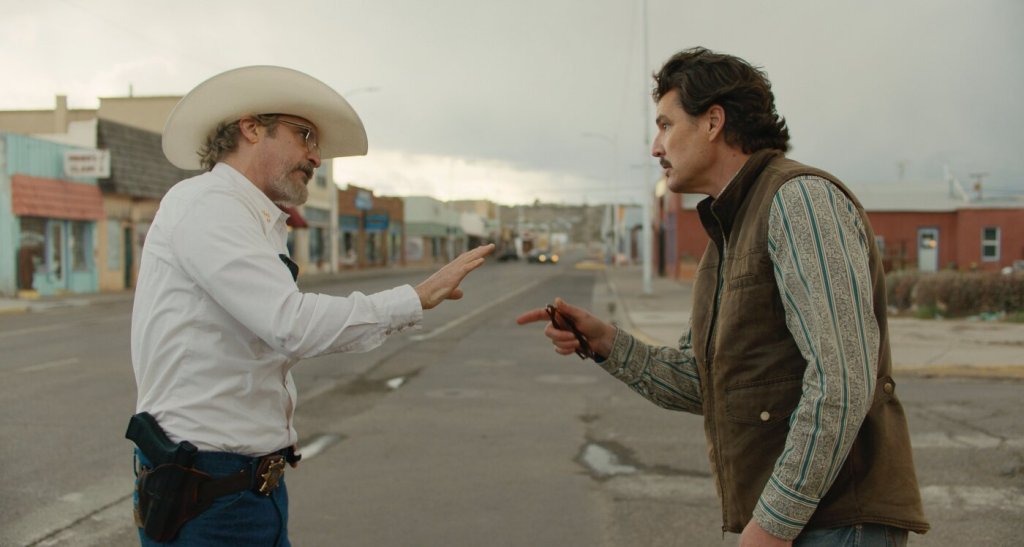
Dee Rees, American independent filmmaker and director of films such as Pariah (2011) and Mudbound (2017), has pointed out in one of her interviews that when you try to tell a story that belongs to everyone “that can quickly make it no one’s story.” This ambition is precisely what undermines Ari Aster’s latest, Eddington (2025). The film is set at the onset of the Covid-19 pandemic in a fictional city in New Mexico, where a mayoral election is about to take place. It centers on the city’s sheriff, mayoral candidate Joe Cross (Joaquin Phoenix), who is meant to be the enforcer of the law, yet at that moment is involved in some shady business around town. He also suffers from asthma and struggles to wear a mask; with no reported Covid-19 cases in town, he views the situation as much ado about nothing!
Cross’s arch nemesis is Eddington’s current mayor and leading mayoral candidate Ted Garcia (Pedro Pascal). He has a history with Cross and his wife Louise (Emma Stone), with whom he was in a relationship twenty years prior. Garcia is determined to turn the town into a hub for Big Tech, and invests in “Solidgoldmagicarp”, a company seeking to build a massive data center in Eddington. Having set up its two main opponents in the mayoral race, the film follows the logic of a duel, pitting them against each other at every turn. The confrontation gradually turns darker and uglier, leading up to a big, final surprise.
The film’s premiere at Cannes was controversial, as many expected; a notable number of viewers walked out during the screening, and the subsequent press conference also stirred controversy. According to some journalists, it became an exercise in “vague-both-sides-ism”, with the creators dodging direct political questions and refusing to take clear positions on the real-world issues that the film addresses, and Aster memorably replying “I don’t speak English!” when asked about the future of the United States. Finally, all hell broke loose when a journalist spoiled a key plot point during the Q&A, which visibly upset Joaquin Phoenix. Amid these controversies, there is little doubt that Eddington marks a turning point in Aster’s career. With Hereditary (2018) and Midsommar (2019), the director established himself as a defining figure in modern horror. Then, with Beau Is Afraid (2023), he stepped into the realm of surrealism. Eddington appears to be his first move beyond genre filmmaking and toward a more overtly auteur-driven cinema. Whether or not one appreciates what Aster achieves here, the significance of Eddington within his body of work is hard to dismiss.
Like several other major films of 2025, including Yorgos Lanthimos’s Bugonia and Paul Thomas Anderson’s One Battle After Another, Eddington sounds an alarm bell about hardline radicalism on both the right and the left, at the same time as it criticizes the rise of conspiracy thinking and racism in the United States and, on a larger scale, the threats posed to democracies and individual freedoms by inward-looking governments around the world. Yet Eddington also diverges from films like Bugonia and One Battle After Another in several important ways. These are, after all, films centering on a single, clearly defined political issue, whether that’s conspiracy thinking (Lanthimos) or radicalism (Anderson)—the rest of their concerns remain marginal. Aster, on the other hand, attempts to address most of America’s contemporary crises within the single narrative frame of the COVID-19 pandemic, and it becomes an almost impossible undertaking. Indeed: he brings these issues into the film with little regard as to what the narrative frame itself can actually sustain, so that by the end it remains unclear whether he intends to achieve something with all the micronarratives and subplots. If anything, he seems content with simply pouring out the vulgarities and dysfunctions of contemporary America onto the viewer and then leaving them suspended in a kind of absolute emptiness.

Some might argue that leaving the audience in such a state —to figure things out on its own— is a good enough objective. This might very well be so, but if a filmmaker wants the warning embedded in his film to have real impact, then the narrative needs to be handled with far greater care. As it stands, Eddington is tonally and structurally adrift. The film wavers between hyperrealism and parody, and its characters are caught in a similar limbo. Many of the comic beats fall flat, and the film’s overall structure could have definitely done without some of its side characters and subplots.
This flaw in character development makes actors like Emma Stone, Pedro Pascal and Joaquin Phoenix, all of whom have delivered remarkable performances in recent years, appear strangely dull on screen. Overall, Aster never quite succeeds in the complicated mission he has set for himself. His Eddington is like a mirror meant to reflect all the wounds of our moment, yet the image it offers, much like Mel’s (Robin Williams) image in Deconstructing Harry (1997), suffers from a small but crucial shortcoming: the picture is “out of focus!”



Leave a comment