As 2023 winds down, our contributors evoke its cinematic spirit in eight short reviews. Navigating through some of this year’s festival favorites and commercial hits, from Nicolas Philibert’s Golden Bear-winning On the Adamant to Martin Scorsese’s much awaited Killers of the Flower Moon, we hope this article can be your guide to a year of rich, standout cinema. Let us know your favorite film of 2023 in the comments and stay tuned for Filmpost 2024!
Annika Gebhard & Panagiota Stoltidou
Click here for Part II of our reviews (in German).
Close, dir. Lukas Dhont
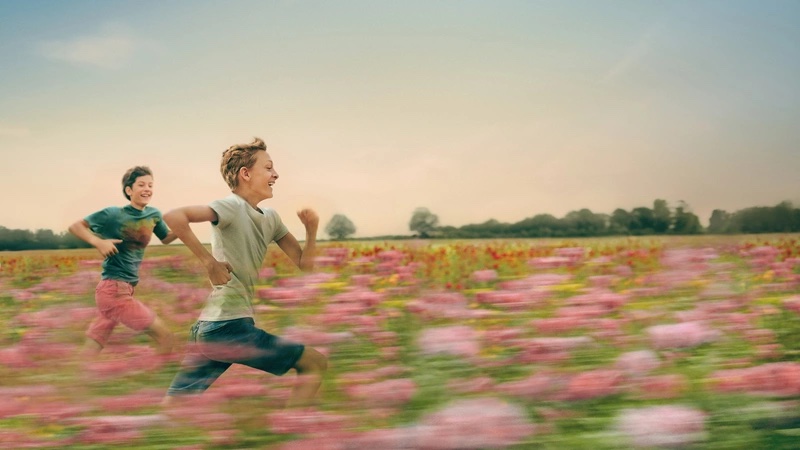
endless fields of rose petaled flowers –
the spontaneity and innocence children carry with them –
two boys, a friendship, so intense and genuine –
societal norms, whispering dissonance between them.
These are some of the tender sentiments that Close by Lukas Dhont left me with.
Léo (Eden Dambrine) and Rémi (Gustav De Waele) enjoy inexhaustibly being in each other’s company, daydreaming, playing, riding their bicycles through the serene landscapes of rural Belgium. They show what an unconditional friendship can look like – but also how a simple question holds the power to derail it.
“Are you two together?”
While a simple “no” would suffice, the question shakes the friendship to its core, leaving us to ponder how a bond so sincere can be profoundly impacted in just a moment. Are social norms powerful enough to determine a friendship between 13-year old boys? Apparently so. In this nuanced coming-of-age film, Lukas Dhont delves into the internalization of bias at a young age and elegantly showcases its effects, while also exploring the sentiments of guilt and forgiveness.
Despite the dramatic events depicted, the cinematography and soundtrack remain tranquil and detached, allowing the honesty of the story to unsettle us. Visually poetic and emotionally poignant, Close offers a fleeting insight into the quest for self-discovery.
Iliana Tsachpini
A Cup of Coffee and New Shoes On, dir. Gentian Koçi
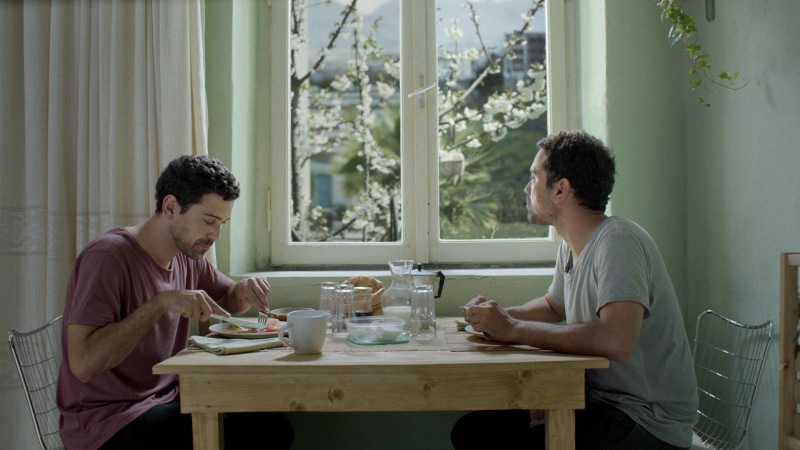
At first glance, this feature by Albanian filmmaker Gentian Koçi doesn’t seem groundbreaking, but ends up being just that. First shown at the 26th Tallinn Black Nights Film festival in 2022, it was Albania’s official submission for the 2023 Oscars. I am so glad I caught the film in its Greek premiere at the 64th Thessaloniki International Film Festival, because it has been in my head since.
A Cup of Coffee and New Shoes On takes place in contemporary Albania (even though it could be anywhere in the Balkans), and the story follows deaf-mute identical twin brothers, Gezim (Edgar Morais) and Agim (Rafael Morais). Even though their daily life doesn’t come without its challenges, in a place that so clearly has no plan for them to exist, they have built a good life for themselves. They make a living working in construction, and have surrounded themselves with people that care for them, like Ana (Drita Kabashi), Gezim’s girlfriend. With those that can’t communicate via sign language, they have found other codes. After Agim almost gets into a deadly car accident, he gets checked by an ophthalmologist and they discover that both he and his brother have a genetic mutation where they will eventually end up blind. Their options are nonexistent, so they choose to react drastically.
They go through this hand in hand, and we go through it with them. As they are losing their sight, we see and hear it all. This film achieves to unmask the face of reality for disabled people in the Balkans. It is a silent protest, and is filmed like that. The discreet camera movements, detailed sound design and performances manage to give an intense experience. For a film full of silences, it ends up loudly claiming space for inclusivity.
Angeliki Dekavala
On the Adamant, dir. Nicolas Philibert

It is no easy task that Nicolas Philibert — known for Être et avoir (2002) and La Maison de la radio (2013) — has set for himself with this year’s Golden Bear winner at the Berlinale: portraying the Adamant on the Seine in the heart of Paris, a psychiatric day clinic and its passengers. Through a sensitive yet direct perspective that acknowledges the realities of the passengers, we get to know the daily life on the ship.
The passengers sing, draw, write poetry, and dance together. They share their stories with each other and with the film crew. As an audience, we can never be completely sure whether the person talking to Nicolas Philibert remembers that they are being recorded. Still, or perhaps precisely for this reason, Philibert manages to portray his protagonists as a whole and to capture their true character. He presents to us real people with real stories, instead of reducing them to their mental health status.
The most beautiful scenes for me are the ones in which the camera captures a moment of music making. The film starts with a scene in which François, one of the frequent visitors of the Adamant and one of my personal favorites, performs his heartwarming version of “La bombe humaine” by Téléphone. There are other scenes of simple but moving piano play or one in which we get to hear an incredibly fine guitar player.
This film invites us to climb aboard and meet the patients and caregivers who, day after day, are doing their utmost to resist the dehumanization of psychiatry. It offers a version of psychiatric care that at times might feel a bit utopian but is truly humane and authentic.
Carla Bäumer
Asteroid City, dir. Wes Anderson
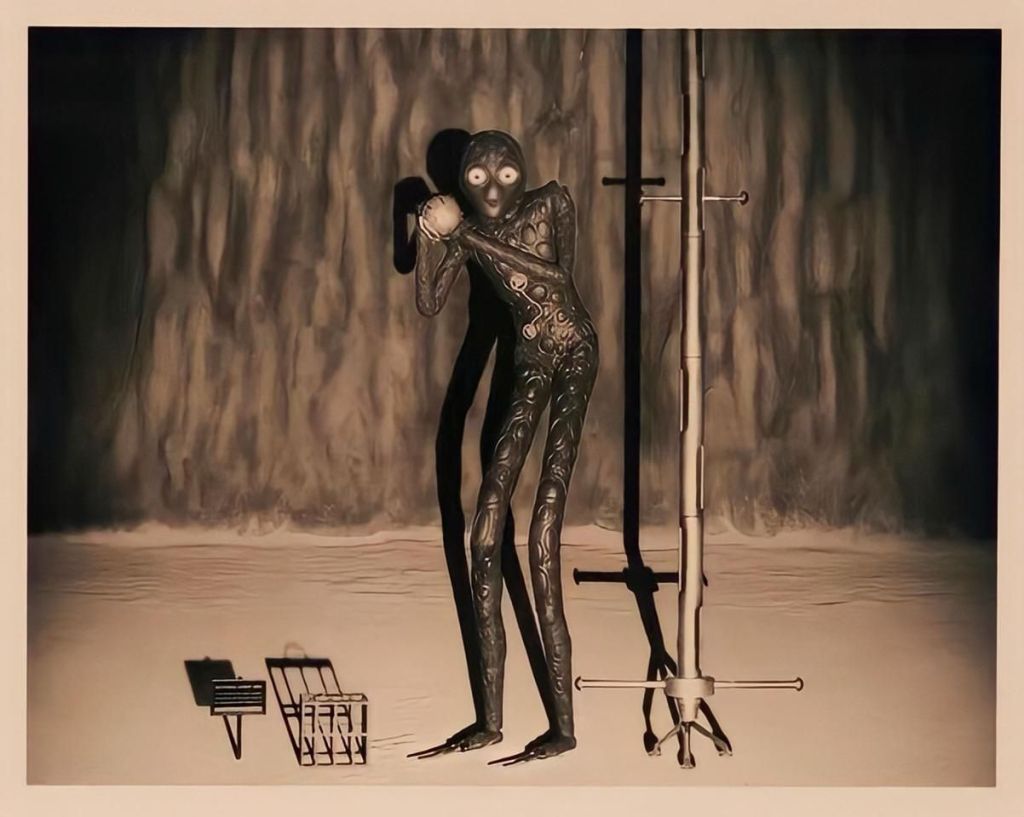
Perusing postcards on a stand somewhere on vacation drags a brush across a palette of pastel sentiments, each softer than the other, leaving no trace behind but the seashells and sand grains of fleeting Riviera twinkles between toes, feeble skin, and retinas.
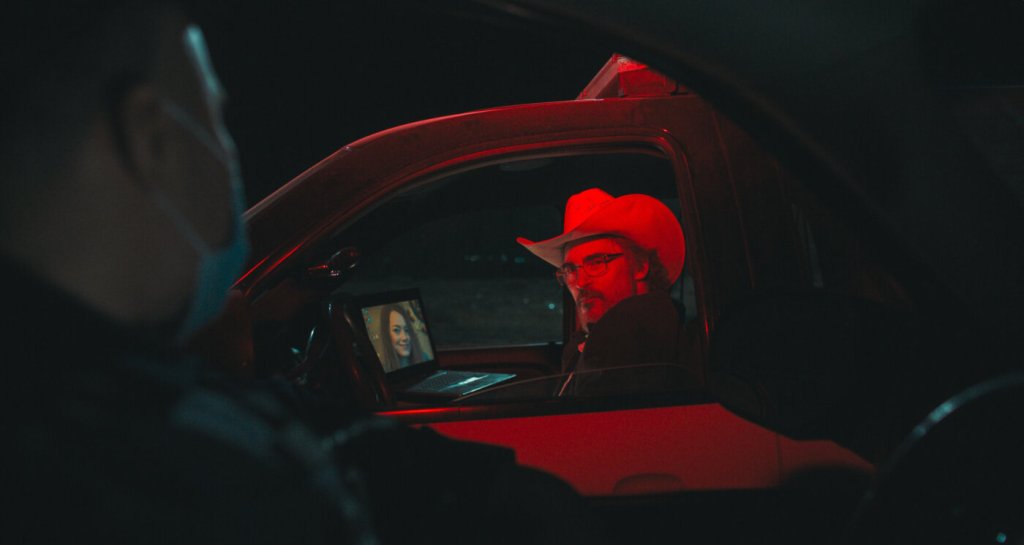
Asteroid City is but a long gaze at a beach trying to ignore the sea, except it’s set in a desert. It’s a classic depiction of Southwestern America, it’s classic Wes Anderson. The stills we see often are satirically square homages to symmetrical American lives: scouts, cowboys, nuclear families and bombs, bombshells in the eyes of a photographer, a photographer scared of his own sight, mysterious ciphers foreboding foreign visitors from faraway, and quarantine — a slippery slope Wes Anderson could not but take with a grain of sand.
Likely, we are tired of likely quarantines and signs foreboding the unlikely.
The film delivers.
Beebeedeebee-dumm-dumm, the people of Asteroid City missed the last train to San Fernando. Beebeedeebee-dumm-dumm, it’s a vacation not yet now and yet forever.
Scarlett Johansson, Jason Schwartzman, the latter’s photos of the former, an all-star cast, looking silver eyed at you, with eyes that tell, “America, I have given you all and now I’m nothing.” To recall the facts and numbers, to present a factual deadpan succession of events never did any lifeline justice; Wes Anderson does what he’s best at: eclectic self-aware cultural satire in postcards 24 frames a second.
Janek Kindel


Leave a reply to 2023: A Year in Film (II) – filmpost BERLIN Cancel reply